

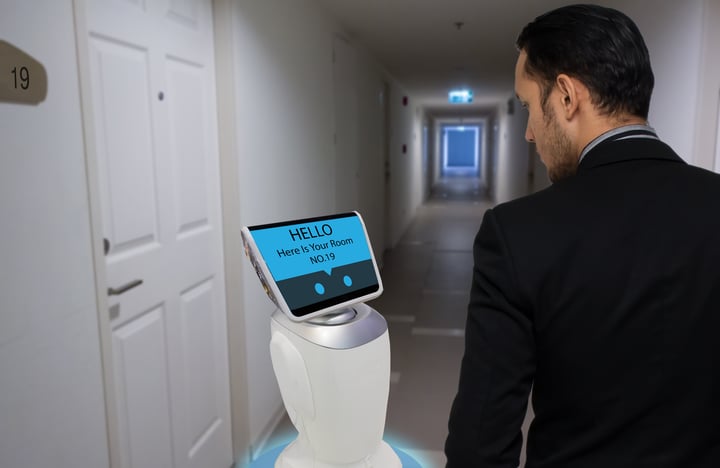

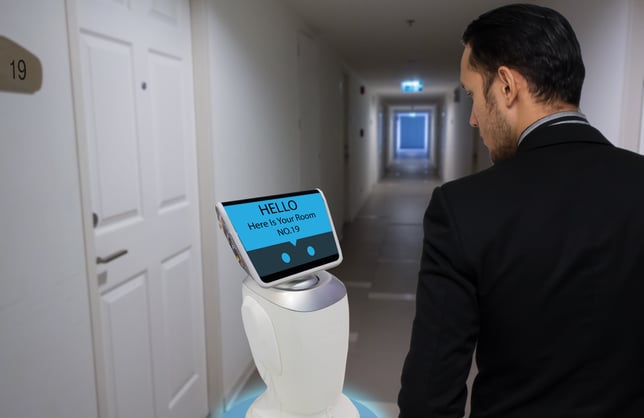
Robots in hotels? It may seem like something out of a sci-fi movie, but with persistent staffing challenges and evolving guest expectations, hotel robots are becoming a real consideration.
This article examines the current state of hotel robotics, the different types of robots used in hospitality settings, prices, implementation challenges, and the future trajectory of automation in the industry.
What are Hotel Robots?
Hotel robots are autonomous machines that use sensors, navigation systems, and artificial intelligence to perform service tasks traditionally handled by human staff.
There are many use cases for robots in the hospitality industry. For instance, delivery units (that are already a fairly common occurrence in grocery stores) can transport items between floors, and housekeeping robots can clean corridors and disinfect surfaces.
In 2026, the market size for hotel robots was valued at $0.76 billion, with a prediction to reach $2.23 billion by 2030.
By 2024, more than 20,000 service robot units had been deployed globally across hotels, restaurants, resorts, and healthcare facilities.
Labor Costs Pushing Owners Towards Hotel Robots
The reason behind the increasing deployment of robots in hospitality is not necessarily a desire to be futuristic. Instead, owners see them as potentially addressing some of the industry's most pressing structural challenges, namely labor costs and high employee turnover rates.
According to STR Global, labor costs now consume approximately 33% of total hotel revenue. Furthermore, employee turnover rates in the hospitality industry spiked after the pandemic and have remained 76% higher than the pre-pandemic levels.

The promise of hotel robots being able to handle and automate certain repetitive tasks makes them attractive to owners who are looking to improve their pressured profit margins.
The ethical standpoint of human staff members being replaced by robots is a discussion that needs to be had in the industry. But for now, the line of reasoning seems to be for robots in the hospitality industry to free up the time of human staff members for higher-impact tasks.
Types of Hotel Robots and Their Applications
Hotel robots can already be deployed in multiple use cases, some of which are already more common in other industries. Below, we look at the different applications of hotel robots in the industry today.
Room Service Robots
Delivery robots lead the hospitality robotics market, accounting for approximately 40% of total revenue in 2025. Depending on the device, these units can autonomously navigate the property and deliver amenities or food directly to rooms.
The technology relies on something called simultaneous localization and mapping (SLAM) algorithms, which means that the robots are able to navigate by creating detailed facility maps.
More advanced models can even include speech recognition and the ability to recognize objects, which enables them to directly interact with guests.
Some market research reports claim that properties that use delivery robots see 20-35% reductions in manual room-service runs. If the numbers are correct, the return on investment for hotels can be significant.
In 2023 alone, over 3,500 hotels globally started using delivery robots.
Housekeeping Robots
Cleaning robots represent the second-largest deployment category in hotels. These machines handle corridor vacuuming, public area maintenance, and disinfection of guest rooms and meeting spaces.
With U.S. hotel occupancy rebounding to approximately 63.6% in 2024 and over 1.3 billion room nights annually, properties face mounting pressure to maintain high cleanliness standards across large facilities.
The housekeeping robot category is growing at a 25.4% compound annual growth rate as operators recognize the ability of automation to stabilize workflows that may otherwise be difficult to staff.
Front Desk and Concierge Robots
Reception robots handle check-in procedures, answer guest questions, authenticate identification, accept payments, and distribute room keys. These units typically feature multilingual capabilities and touchscreen interfaces.
AI-powered concierge robots, which are still rare, can provide local recommendations, book restaurant reservations, and respond to facility inquiries.
According to market research, over 4,200 hotels adopted AI concierge robots in 2023. Front-of-house applications accounted for 58.02% of 2024 robot implementations.
Security and Surveillance Robots
Hotel security robots can, for instance, patrol parking and outdoor areas. Some devices stream 360-degree video to centralized command centers and trigger real-time alerts when any suspicious patterns are detected.
Security and surveillance robots are projected to accelerate at a 27% compound annual growth rate through 2030. This growth is buoyed by favorable insurance premiums for properties that employ active monitoring systems.
Hotel Robot Price: Understanding the Investment
The cost of robots in hotels varies dramatically based on functionality and autonomy level.
According to Market Growth Reports, delivery robots start at approximately $15,000-$20,000 for purchase, while fully autonomous delivery or concierge robots range from $15,000 to $45,000.
Advanced humanoid robots capable of complex guest interactions can exceed $66,000, positioning them as a solution primarily for luxury properties.
That said, market dynamics have created significant downward pressure on hotel robot prices.
Industry analysis from China reveals that average delivery robot prices dropped from approximately $18,000 initially to around $1,400-$2,800 currently, representing price declines exceeding 90% over several years, reflecting intense competition and scale efficiencies coming from increased manufacturing.
Leasing hotel robots is an option for properties looking for a way to acquire them with minimal upfront investment, paying instead through monthly subscription fees that include maintenance and software updates.
And importantly, the total cost of ownership of hotel robots is higher than the purchase price. Staff training and possible ongoing subscriptions or maintenance services all add up.
Still, average annual operating costs for robots run approximately 35% lower than equivalent human labor (but the quality of service is a whole other topic).

Return on Investment and Operational Impact
ROI timelines vary by robot type and deployment context.
For instance, leased robots can achieve positive ROI from month one if they displace even partial staffing needs.
Deloitte research found that almost all airports and half of all hotels are adopting new technology to address labor shortages.
Efficiency gains have proven to be substantial, as properties report that tasks such as corridor deliveries and vacuuming consume significantly less staff time.
Implementation Challenges
High initial capital expenditure remains the primary restraint for properties interested in deploying hotel robots.
In 2023, more than 60% of small hotels in Southeast Asia cited cost as the biggest barrier to robotic service technology adoption.
Furthermore, integration can be complex and present operational challenges. Connecting robots to existing property management systems requires technical expertise, and the initial mapping and configuration phase of the devices demands dedicated time from hotel operations teams.
While navigation technology has advanced dramatically, robots still remain vulnerable to WiFi connectivity issues and software glitches that can disrupt service.
The Future of Robots in Hospitality
Asia-Pacific leads deployment with 55% market share, driven by China, Japan, and Singapore, while North America and Europe show rapid growth in luxury and mid-scale segments.
Future developments of the market are robots suited for multiple purposes, and recent launches have showcased robots that are capable of both delivery and cleaning tasks. Furthermore, as the robot fleets of properties grow larger, solutions for fleet management will emerge as an added service layer.
Healthy Skepticism from Hoteliers?
According to Deloitte research, only one in four hoteliers believes AI can significantly improve guest service, and 54% feel available technology is not sufficiently advanced to meet evolving customer demands.
The industry continues to face the challenge of striking a balance between optimizing operations through automation and authentic human connection, which, at the end of the day, is one of the core selling points of hospitality experiences.
The best way for properties to approach the deployment of hotel robots is to identify high-impact use cases, which are typically cleaning or room delivery-related.
A pilot period is important to measure the changes, for instance, in delivery times and guest satisfaction scores. If it doesn't move the needle, then we know that broader rollout is not viable.
Robots are already changing hospitality operations, and hotel robots will continue to garner interest as labor challenges intensify and guest expectations for contactless convenience rise.




![Hotel OTAs: Their Business Model Explained [With Complete List]](https://insights.ehl.edu/hs-fs/hubfs/Blog-EHL-Insights/Blog-Header-EHL-Insights/booking-hotel-choices.jpg?width=403&height=266&name=booking-hotel-choices.jpg)