




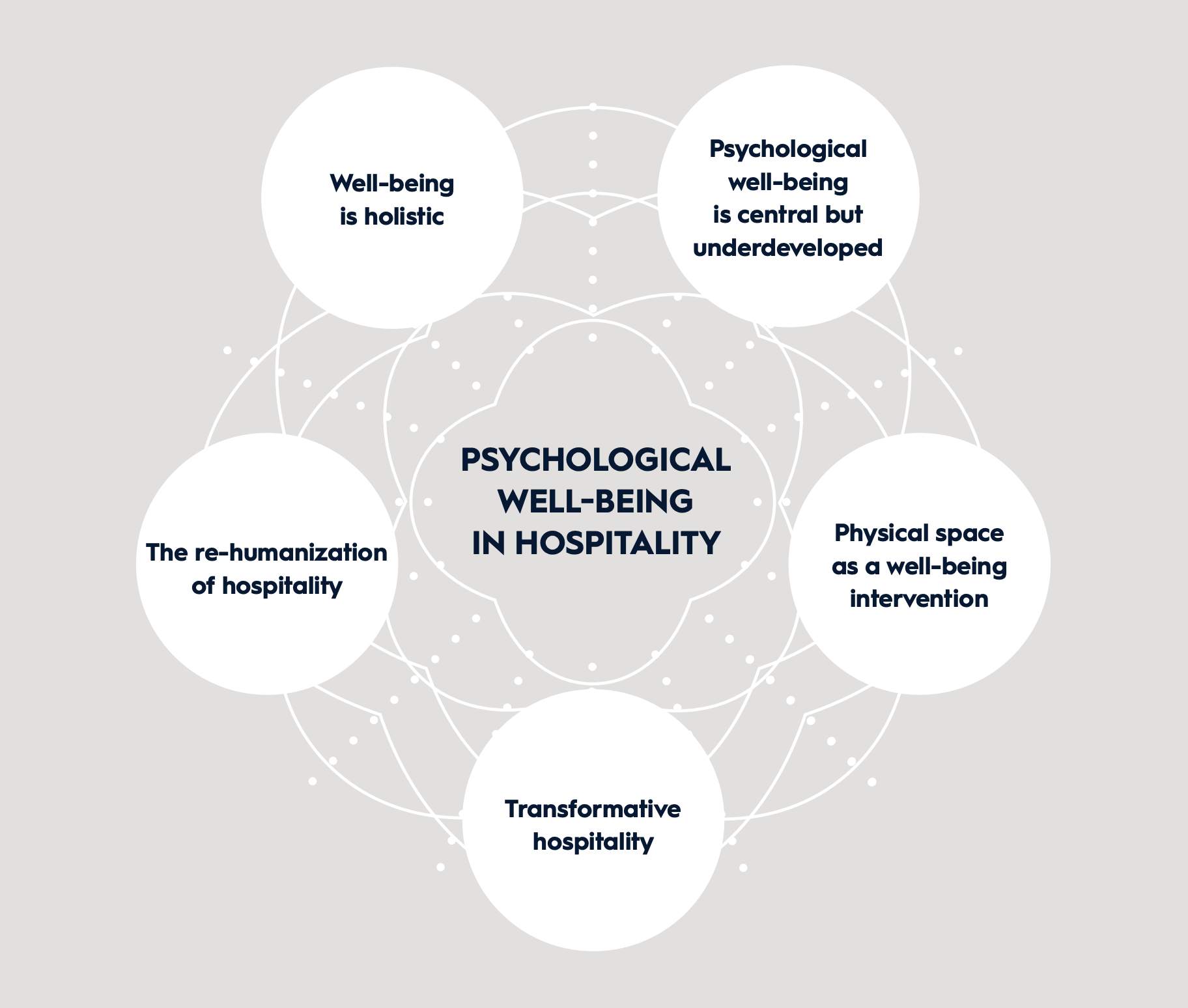
The Psychological Well-being in Hospitality Report 2026, the second edition of EHL's Well-being Report Series, illuminates this rarely discussed topic. Written by Dr. Valentina Clergue and Nicola Gryczka Kirsch, the report draws from 48 in-depth interviews with experts across academia and industry. It identifies five developments that redefine how the industry understands psychological wellbeing for guests and staff alike.
The hospitality industry has spent the past decade focusing on building visible wellness in its different manifestations: gyms, spas, sleep menus, yoga mats in the room, and even meditation channels on the in-room television. But wellness contains multitudes beyond the visible, and how a guest or employee feels throughout the hospitality experience has been largely left out.
Key Takeaways
- Wellbeing is holistic, but industry practice is fragmented, with most programs addressing one or two dimensions at a time.
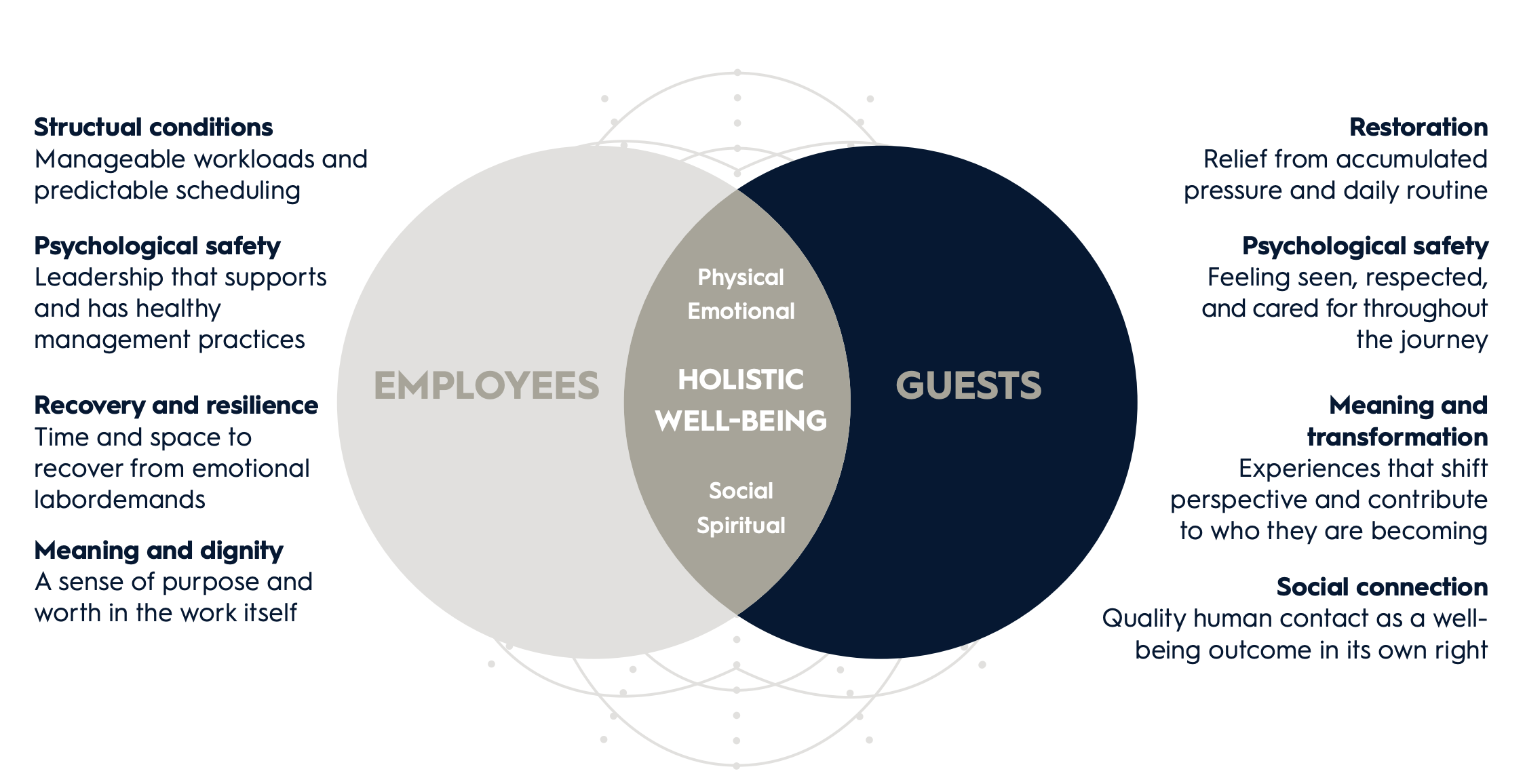
- Employee psychological health determines guest experience quality, meaning that the relationship between the two is structural.
- Guests increasingly seek meaning and change from their stays rather than comfort alone, which the report frames as the transformation economy.
Wellbeing is Holistic: Beyond Body, Beyond Mind

The report's first finding is that wellbeing cannot be reduced to a single metric or amenity. Physical, mental, emotional, social, spiritual, and financial dimensions of wellbeing all interlock, and when there is imbalance in one area, it has a ripple effect on the others.
While there arguably is more awareness than ever when it comes to wellbeing, most of the interviewed experts agree that practice in the hospitality industry has not caught up. Implementations are still fragmented, and are aimed at addressing one or two dimensions at a time, which leaves the rest unattended to.
"A meditation app on the television, a pillow menu, and access to a fitness center are additions to an otherwise transactional experience. They do not constitute a wellbeing strategy," says Elina Ivanova-Atanassov.
The report also argues that wellbeing is not culturally neutral. Most prevailing frameworks originate in Western academic traditions, but effective wellness frameworks should accommodate cultural plurality in order to be able to produce the desired outcome of wellbeing.
Psychological Wellbeing Is Central But Underdeveloped
-1.png?width=2336&height=1142&name=image%20(3)-1.png)
Hospitality is a psychological business. Every interaction and environment either supports or erodes the psychological wellbeing of the people involved; yet investment is often concentrated on the visible that can generate immediate returns.
Dr. Aradhana Khowala calls what gets left out invisible wellbeing: the emotional design of the guest journey, and the psychological safety and recovery infrastructure of employees.
On the employee side, there are many structural challenges that the hospitality industry faces. Dr. Natalie Grinvalds describes the current state of employee wellbeing in hospitality as neglect that is dressed in the language of care, pointing to chronic understaffing, unpredictable scheduling, and a cultural normalization of hardship as professional identity.
Dr. Alyson Meister names the "badge of honor" myth that hospitality work has to be grueling, an inheritance the report traces back to Escoffier's militarized kitchen brigade. Dr. Joanna Blatter Minn cites research finding that between 47% and 90% of workers have experienced some form of harassment, most often involving customers and managers.
The understanding of psychological wellbeing in hospitality is also hindered by the lack of vocabulary around it. Wellbeing and wellness can be used both in the context of a spa menu and mental health awareness day. This leads to the term losing authority, and organizations being able to claim commitment to wellbeing while undermining psychological health in practice.
The Re-Humanization of Hospitality
Decades of standardization in the industry has delivered consistency, but it has perhaps come at the cost of relational warmth. Now, guests are looking for human connection from their hotel stays.
The report shows that employee psychological wellbeing determines guest experience quality. Rainer Stampfer of Four Seasons Hotels & Resorts frames service excellence as an emotional exchange, which is something that a drained or anxious team cannot produce.

However, technology is not the antagonist and is not here to replace the human in the equation. The report positions automation as a useful tool for reducing friction around human connection, and to support the rising demand for personalization in hotels.
For making the commercial case, Dr. László Puczkó introduces ROX, or Return on Experience, which looks at guest psychological wellbeing as a measurable driver of loyalty and advocacy.

Physical Space as a Wellbeing Intervention

Our environment highly affects our psychological wellbeing, and there is an emerging field of research in environmental psychology and neuroarchitecture. Room proportions, ceiling height, acoustic density, lighting temperature, and circadian alignment are all shown to produce measurable effects on human stress response.
While aesthetics are important, designer Adam D. Tihany says that spaces are now being orchestrated around how they make the body and mind feel. Wellness is being quite literally built into the next generation of hotels, and no longer treated as a collection of amenities.

In short, there is a shift from amenity to infrastructure. Forestis in the Dolomites, a case study in the report, has no separate wellness program. Restoration is distributed throughout the stay through nature immersion and acoustic protection, as well as a deliberately minimal visual complexity in the property’s design. Ett Hem in Stockholm achieves something similar with a very different approach, as they have blurred the distinction between the front-of-house and back-of-house functions to make the space feel home-like.
Transformative Hospitality

The ethos of efficiency that has driven the hospitality industry for a long time is reaching its limits, and consumers are disenchanted with commodities.
What guests increasingly want is eudaimonic rather than hedonic: meaning, growth, and perspective instead of comfort or pampering alone. The report connects this to Pine and Gilmore's theory of the transformation economy, which is a successor to the experience economy framework, where consumers seek change in how they think and feel.
There are ethical considerations related to the extent of responsibility that hotels and staff can take for the wellbeing outcomes for guests, but hospitality does have a unique position to offer the conditions in which wellbeing can happen.

Why Psychological Wellbeing in Hospitality is a Leadership Question
What used to be wellbeing-related initiatives are now becoming part of the infrastructure of the hospitality industry. That said, only focusing on visible wellbeing will not produce the tangible results and transformation that guests are increasingly seeking. Furthermore, on the employee side, that level of service cannot be sustained without a recognition of and investment in the psychological wellbeing of hospitality staff.
Many leaders who were interviewed for the report are not yet equipped for the full extent of what is being asked of them, since expectations have moved a lot faster than training. But when it is successful, the case studies show positive results.
For example, The Breakers Palm Beach is a pioneer with its employee wellbeing model that includes an on-site mental health counselor and appointments taken on the clock so that staff are paid for the time. The property reports 93% retention among salaried staff and a 94% Great Place to Work score against a US national average of 57%.
Download the full report for all five key developments, the industry recommendations attached to each, and the complete set of case studies and expert interviews.