


Michelin recognition has long been associated with white tablecloths, refined dining rooms, and metropolitan prestige. Well, at least that’s the movie version.
The reality is different, as the Michelin Guide states that stars are not awarded for luxury, scale, or location, but for culinary excellence expressed through consistency, technique, and clarity of intent, wherever that may be found.
This article challenges the assumption that the Michelin star certificate belongs exclusively to conventional fine dining. By exploring restaurants operating in unexpected settings, from remote landscapes to unconventional architectural spaces, it highlights how Michelin recognition continues to reward substance and excellence over spectacle and appearances.
What Is a Michelin Star Certificate?
The term Michelin star certificate is often used informally to describe Michelin recognition, even though the Michelin Guide does not issue a formal certificate in the traditional sense. Instead, the star itself functions as a powerful professional credential, signaling that a restaurant meets the Guide’s exacting standards. Awarded annually, it’s a mark of trust for diners and a benchmark of achievement within the global hospitality industry.
Another common misconception is that Michelin stars are awarded to individual chefs. In reality, the recognition is given to the restaurant, not the person, even though a chef’s leadership, vision, and consistency are central to the outcome. Stars are reassessed every year, meaning they can be retained, upgraded, downgraded, or removed. This annual review reinforces the idea that Michelin recognition reflects sustained performance, not a lifetime achievement.
The Michelin Guide applies a clear hierarchy, as restaurants may receive one, two, or three stars, reflecting increasing levels of culinary distinction. Alongside stars, the Guide also awards the Bib Gourmand to establishments offering high-quality cooking at more accessible price points, and the Green Star to restaurants demonstrating a strong commitment to sustainable gastronomy. Together, these distinctions illustrate that Michelin recognition is not limited to luxury dining, but spans a wide range of culinary expressions.
Understanding what the Michelin star represents (and what it doesn’t) helps place the recognition in context. It explains why restaurants in modest, remote, or unconventional settings can earn Michelin distinction and why the star remains one of the most influential benchmarks in global hospitality.
How Restaurants Earn Michelin Recognition
Michelin recognition carries prestige precisely because it is grounded in a disciplined and highly controlled evaluation process. Far from being a one-off judgment, the awarding of a Michelin star certificate reflects consistent excellence observed over time by the Michelin Guide and its inspectors.
According to the Michelin Guide, all assessments are conducted anonymously. Inspectors book tables like any other guest, pay their bills in full, and return multiple times before a decision is made. This repetition is essential. A single outstanding meal is not sufficient; inspectors look for the ability to deliver the same level of quality consistently, across seasons and service periods.
Evaluation is based on five universal criteria: the quality of the ingredients, mastery of cooking techniques, harmony of flavors, the personality of the cuisine as expressed through the menu, and consistency over time. Eagle-eyed readers may have noticed that factors such as décor, service style, location, or reputation are absent from that list, and that’s because the focus remains firmly on what arrives on the plate.
Hopefully, this demystified the Michelin star experience and explains why restaurants operating in modest settings, remote regions, or unconventional environments can earn the same distinction as established fine-dining institutions, provided they meet the same exacting standards.
What It Takes to Become a Michelin-Star Chef
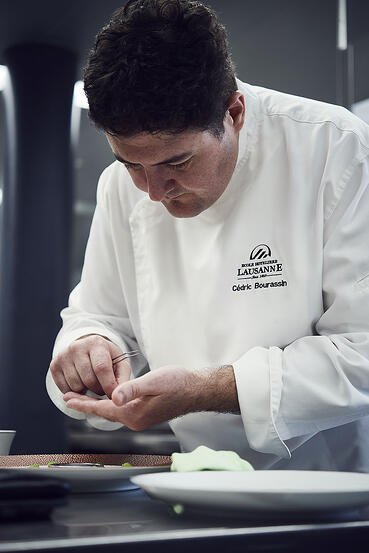
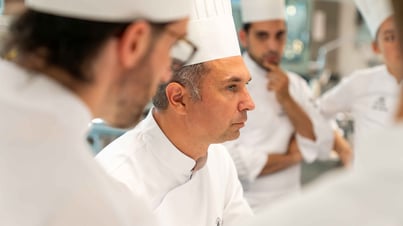
Chef Cédric Bourassin
Becoming a Michelin-star chef is rarely the result of a single defining moment. It is far more often the outcome of years of repetition, restraint, and an uncompromising commitment to the craft. While the Michelin star itself is awarded to a restaurant, the standards required to achieve and sustain that recognition are inseparable from the chef’s personal discipline and leadership.
Across Michelin-starred kitchens worldwide, technical mastery is non-negotiable. In order to earn their star, chefs are expected to demonstrate absolute control over cooking methods, timing, and flavor development, skills that are often refined through years of working under demanding mentors and in high-pressure environments. International experience is common, not for prestige, but for exposure to different culinary philosophies, ingredients, and operational cultures.
Consistency is equally important, as Michelin inspectors return multiple times, sometimes over several years, and judge whether excellence can be reproduced day after day, week after week. This is why repetition matters as much as creativity. For example, in Singapore, Malaysian chef Chan Hon Meng (also known as ‘Hawker Chan’) runs the first ever street food stall to be awarded a star, and his discipline of producing the same dish hundreds of times a day to the same standard proved as decisive as any fine-dining innovation.
Leadership also plays a central role. Kitchens awarded with a Michelin star certificate are team environments, and the chef’s ability to train, motivate, and retain talent directly affects performance. At EHL’s teaching restaurant, Le Berceau des Sens, for example, excellence is maintained despite constant staff rotation, demonstrating that systems, culture, and clear standards can be as influential as individual brilliance.
Beyond technique and leadership, today’s Michelin-star chefs are increasingly defined by passion and dedication. Values such as sustainability, seasonality, and respect for local producers shape menus, sourcing decisions, and kitchen practices.
Perhaps most importantly, successful chefs do not pursue Michelin recognition as an end goal. The daily focus remains on continuous learning to improve dishes, refine processes, and deliver an experience that feels honest, coherent, and personal. It’s this long-term mindset that most consistently precedes Michelin recognition.
Why Michelin Recognition Still Matters
Michelin recognition continues to carry weight because it operates as a shared professional reference point in a global industry that is otherwise highly fragmented. For chefs and hospitality professionals, a Michelin star certificate signals that a restaurant meets a clearly defined standard of excellence, assessed independently and reassessed regularly. This credibility remains valuable precisely because it is difficult to obtain and perhaps even harder to sustain.
From a business perspective, Michelin recognition obviously influences guest demand, but it also plays a role in talent attraction and retention, drawing professionals who want to work in environments where standards are clearly articulated and rigorously applied. For restaurants, the Michelin star certificate can also make it easier to build strong relationships with suppliers, investors, and local partners, as it signals reliability, professionalism, and a consistent commitment to quality.
Michelin recognition also helps keep local food traditions alive while allowing them to grow. By valuing cooking closely tied to regional ingredients and seasonal practices, the Guide supports cuisines that might otherwise be overshadowed by more commercial or standardized dining. At the same time, it gives chefs the freedom to modernize and reinterpret these traditions, finding new ways to express their heritage without losing what makes it meaningful.
Perhaps most importantly, Michelin visibility does not require compromise, allowing restaurants to remain faithful to their values while gaining international attention. In this sense, Michelin recognition continues to matter not because it defines success but because it recognizes it, wherever it is found and however it is expressed.
Case Studies: Michelin Stars Beyond Conventional Dining
The Michelin star certificate has never been limited to grand dining rooms or urban centers. Some of the most compelling examples of Michelin-starred restaurants demonstrate how excellence can exist in modest, remote, or unconventional settings, provided the fundamentals of quality, consistency, and culinary identity are firmly in place.
- In 2016, Hong Kong Soya Sauce Chicken Rice & Noodle made history by becoming the first street food stall to receive a Michelin star. Run by chef Chan Hon Meng in Singapore’s Chinatown, the humble hawker stall gained recognition through the disciplined repetition of a single dish executed to an exceptional standard. Long queues and modest pricing show that, for Michelin, what really matters is how good the food is, not how fancy or expensive the restaurant looks.
- A very different environment can be found at Le Berceau des Sens, the training restaurant of EHL Hospitality Business School. Despite constant staff rotation and its educational mandate, the restaurant has maintained Michelin-star standards through clear systems, strong leadership, and a rigorous approach to technique and sourcing. Its recognition demonstrates that consistency can be achieved even in a learning environment, provided standards are uncompromising.
- In rural Haute-Savoie, Moulin de Léré occupies a former mill far from major gastronomic centres. Here, chefs Frédéric Molina and Irene Molina have built a cuisine rooted in seasonality, local suppliers, and environmental responsibility. The restaurant’s Michelin star reflects a coherent culinary identity shaped by place, patience, and close relationships with producers.
- On Norway’s southern coast, Under is built into the rocky shoreline, partially submerged beneath the North Sea. Europe’s first underwater restaurant offers diners views of marine life through a panoramic window, yet its Michelin recognition rests firmly on its seafood-focused cuisine and respect for local ecosystems, rather than architectural novelty.
- Few restaurants are as geographically isolated as KOKS, which has operated in both the Faroe Islands and Greenland. Accessible only by boat in some locations, KOKS centers its menus on ancient Nordic practices such as fermentation and preservation. Its Michelin star acknowledges a deep engagement with place and tradition under some of the most challenging operating conditions in the industry.
- Equally remote was Fäviken, set amid snow-covered landscapes in northern Sweden. Chef Magnus Nilsson’s approach relied heavily on local produce, curing, pickling, and seasonal limitation. The restaurant’s recognition showed that culinary excellence can thrive far from supply chains and urban influence when technique and intent are sharply defined. Chef Magnus Nilsson closed the restaurant in 2019 to focus on his family, but the farm section of the project is still alive.
- In Sicily, Locanda Don Serafino is carved into an ancient cave beneath the historic town of Ibla. Its intimate setting enhances the dining experience, but Michelin recognition reflects the precision and balance of its cuisine, which draws on regional traditions.
- Amsterdam’s De Kas occupies a former greenhouse, where much of the produce is grown on site and harvested the same day it is served. The restaurant’s menu changes with the seasons, reinforcing a close link between ingredient quality and culinary expression.
- Near Madrid, El Vagón de Beni revives the romance of railway dining inside restored vintage carriages. While the setting evokes nostalgia, the cuisine remains focused and adaptable, supported by a deliberately short menu.
- Within Kyoto’s Tenryu-ji temple complex, Shigetsu serves shojin ryori, a traditional Buddhist vegetarian cuisine. Diners sit on tatami mats in a serene setting, where simplicity and discipline shape both the food and the experience.
- Tokyo’s Tsuta tells a different story. A small ramen shop in the Sugamo district, Tsuta became the first ramen bar to earn a Michelin star. Gourmet ingredients and meticulous technique elevate a familiar format, reinforcing that Michelin standards apply equally to everyday cuisine when executed with exceptional care.
- Hidden behind a code-locked door in a working New York City subway station, Nōksu offers a seafood-focused Korean tasting menu in an unlikely urban setting. Its discreet location proves that Michelin recognition follows culinary clarity and execution, not visibility or scale.
- Off the western coast of Norway, Iris operates inside the floating “Salmon Eye,” an architectural structure dedicated to aquaculture education. The restaurant’s extended tasting menu highlights underutilized marine ingredients while raising awareness of ocean sustainability.