




Key Takeaways
- Senior living exists along a continuum, from independent and home-based living through community support to residential and highly clinical care.
- There is no single global senior living model. Approaches vary across healthcare systems, funding, regulation, family structures, and cultural expectations, with markets such as the US, Japan, Australia, Switzerland, and China taking different paths.
- What residents value is not just what services are offered, but how well they are delivered. Operational quality depends on matching their care needs with the right service model, workforce, and resident experience.
Population aging is reshaping economies and care systems around the world. By 2050, one in six people globally will be aged 65 or over, up from one in 11 in 2019, according to the United Nations. But senior living does not follow a single global model. Healthcare systems, funding structures, family expectations, and cultural attitudes toward aging all influence how and where older adults receive support.
For operators, investors, and leaders building later-life environments, understanding the different types of senior living is more than a matter of terminology. Each carries its own staffing, service, and operational requirements. A community designed for active retirees demands a very different operating discipline than one caring for residents with advanced dementia.
Those models also differ by market. The US has developed a large private senior living sector spanning independent living, assisted living, and continuing care communities. Japan connects home, community, and institutional services through a standardized long-term care system, while Switzerland emphasizes independence and community-based living. Australia has an established retirement community sector, and China is developing its own mix of home-based care, serviced senior apartments, and integrated retirement communities.
This guide breaks down the main senior living and care models, who they serve, and what they require operationally. Across them runs a common lesson: the physical environment alone does not determine quality. Increasingly, differentiation comes from how consistently services and experiences are delivered.
What Are the Main Types of Senior Living?
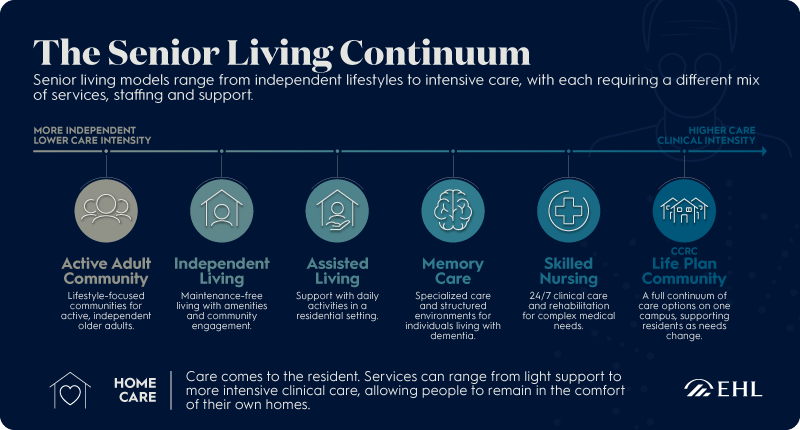
Senior living is best understood as a continuum, organized around two variables: how independent a resident is and how much care they need. On one end sit active, healthy older adults who want a lower-maintenance lifestyle. On the other are those with complex medical needs requiring around-the-clock clinical supervision.
Senior living takes different forms around the world, shaped by healthcare systems, funding models, family structures, and cultural expectations around aging. The terminology varies too. What one market calls assisted living, retirement living, or a life plan community may have no direct equivalent elsewhere.
Despite those differences, most models can be understood along a common continuum: from independent living with little or no formal support, through home- and community-based services, to residential settings providing increasingly intensive personal and clinical care.
The most common types of senior living include:
- Independent living — for active adults who can care for themselves
- Home- and community-based care — professional support delivered in a senior's own home
- Assisted living — for those needing support with daily activities
- Memory care — for adults living with Alzheimer's disease or dementia
- Nursing homes (skilled nursing facilities) — for those needing 24-hour clinical care
- Continuing care retirement communities (CCRCs) — all care levels on one campus
- Active adult communities — age-restricted housing for independent retirees
Additional models, including adult day care, respite care, and emerging luxury and wellness-focused communities, further extend the spectrum. Each is explored below.
What Is Independent Living, and Who Is It Designed For?
Independent living communities cater to active adults, typically older than 60, who can care for themselves but want to shed the burdens of home ownership. These communities often feel closer to a resort than a care setting, with amenities such as swimming pools, fitness centers, walking paths, and multiple dining venues.
In the United States, independent living communities cost around $3,065 per month, according to SeniorLiving.org. That figure typically covers an apartment, utilities, security, and access to amenities. Services like housekeeping, laundry, and transportation may be included or offered at an additional charge.
Crucially, independent living does not provide on-site caregivers around the clock. Independent living generally does not provide around-the-clock personal care. Clinical support, emergency response, and security arrangements vary by community and market, while residents typically remain responsible for managing their own daily care. The resident, not the community, manages their own daily care.
The form this takes varies considerably by market. Australia's established retirement village sector provides one mature example, while Switzerland places greater emphasis on enabling older adults to remain independent and embedded in existing neighborhoods and communities.
In China, newer serviced senior apartments are emerging between conventional housing and institutional care, combining independent living with hospitality-style services and optional support.
What it requires operationally: Independent living leans heavily on facility management, hospitality, and lifestyle programming rather than clinical care. The competitive advantage lies in dining quality, social engagement, and the maintenance-free promise.

Research cited by HumanGood indicates that social connection is a strong predictor of longevity, making programming and community design core to the value proposition rather than optional extras.
How Do Home- and Community-Based Senior Living Models Work?
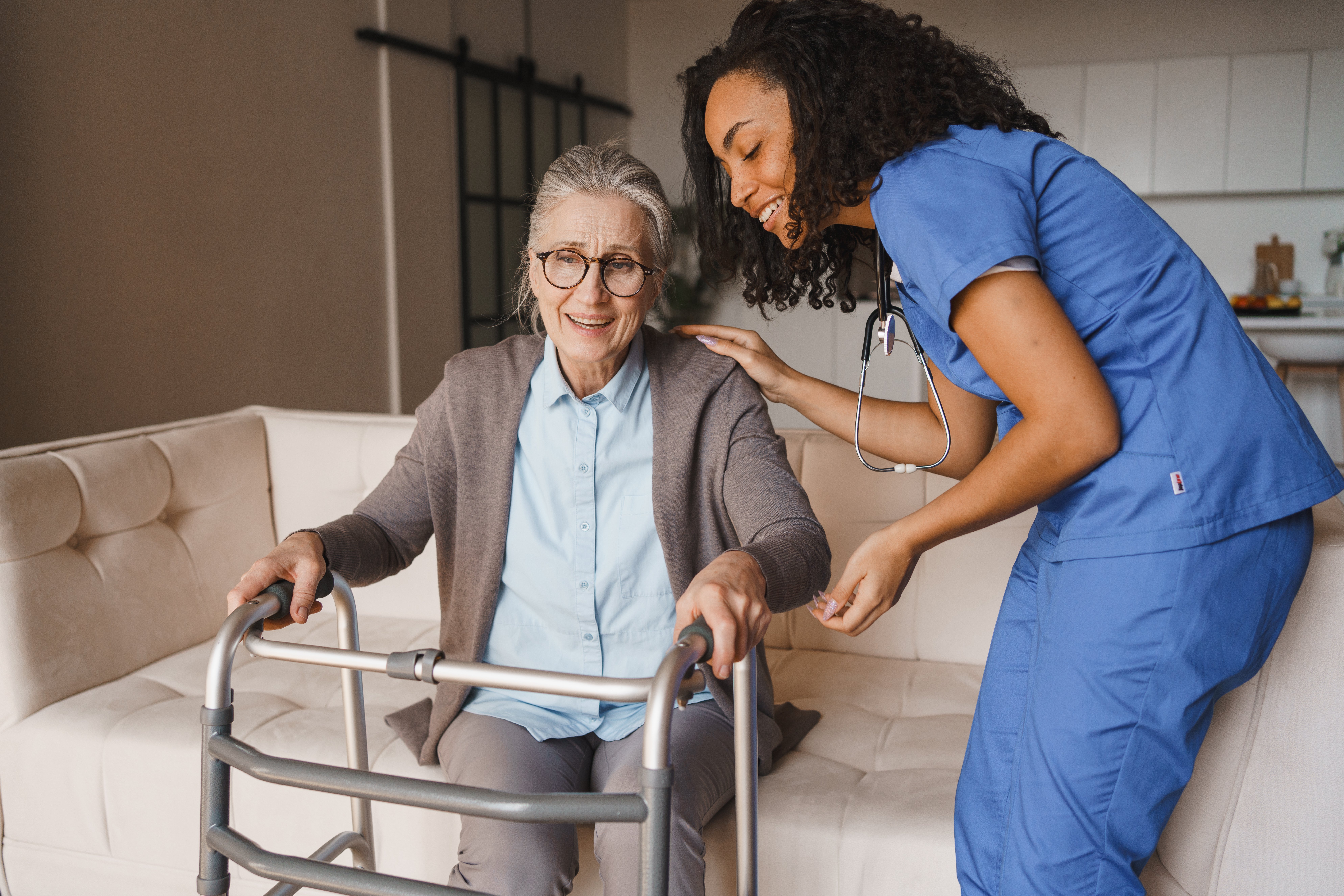
Home- and community-based care allows older adults to remain in familiar surroundings while receiving increasing levels of professional support. Services can range from meals, housekeeping, and personal assistance to nursing, rehabilitation, and more intensive care.
This approach is central to senior care systems in many markets. China formally organizes elderly care around home-, community-, and institution-based provision, while Japan's established long-term care system combines preventive services, day programs, home nursing, and residential care according to assessed need. Switzerland similarly emphasizes supporting independence within existing homes and communities for as long as possible.
What it requires operationally: Home care providers manage a dispersed workforce rather than a central facility, which makes scheduling, caregiver training, and quality consistency the primary challenges. Rising demand is also putting pressure on the US care workforce. Research by MIT professor Paul Osterman estimates a national shortfall of 151,000 paid direct-care workers by 2030, rising to 355,000 by 2040. Coordinating reliable, high-quality care across many private homes is an operational discipline in its own right.
Case study: Taking residential care into the home
Shanghai Happy Home Nursing Home shows how the distinction between residential and home care is becoming more fluid. Originally a 96-bed nursing facility, the operator began extending its staffing, routines, and care standards into residents' homes through a “family care bed” model. It has since evolved into a wider network of community care centers, emergency response systems, and coordinated home services supporting approximately 60,000 seniors.
The model illustrates a broader shift in senior living: care does not always have to be tied to a physical facility. Professional services can increasingly follow residents as their needs change.
What Is Assisted Living, and Who Does It Serve?
Assisted living communities support older adults who benefit from extra help with daily activities but do not require intensive medical care. Residents typically need verbal or hands-on support with a limited number of activities of daily living, such as bathing, dressing, or managing medications.
In the United States, this intermediate level of support is commonly delivered through assisted living communities. Elsewhere, similar needs may be met through community care, supported housing, home-based services, or other models rather than a dedicated assisted living facility.
The scale of this sector is substantial. According to the AHCA/NCAL Facts & Figures, there are approximately 41,465 assisted living communities with nearly 1.4 million licensed beds across the United States, housing nearly 1.2 million residents. The financial commitment is equally significant: the national median cost is $6,200 monthly, or $74,000 annually, per the CareScout 2025 Cost of Care Survey.
Unlike independent living, assisted living provides caregivers on-site 24 hours a day, along with medication management, transportation, housekeeping, and dining. The resident population skews older and more medically complex: over half of residents have high blood pressure, and 4 in 10 are living with Alzheimer's disease or other dementias.
What it requires operationally: Assisted living is staffing-intensive and demands robust medication management, emergency response, and care coordination while preserving the residential, non-institutional environment that residents and families expect.
What Is Memory Care, and What Does It Demand From Operators?
Memory care refers to specialized environments and services for people living with Alzheimer's disease or other forms of dementia. In some markets, particularly the United States, this is delivered through dedicated memory care communities or specialist units within assisted living and nursing facilities. Elsewhere, dementia support may be integrated into residential, community, or home-based care.

Demand for dementia care and support is increasing as the number of people living with dementia rises worldwide. According to Alzheimer's Disease International, as of 2020, more than 55 million people worldwide are living with dementia. This figure is projected to rise sharply in the coming decades, with estimates suggesting it will reach 78 million by 2030 and 139 million by 2050—nearly doubling every 20 years.
These communities can be licensed as either an assisted living community, the most common arrangement, or a nursing home. Memory care typically costs more than standard assisted living but less than a nursing home. Monthly fees generally include room and board, meals, activities, transportation, housekeeping, and around-the-clock nursing and caregiver support.
The design philosophy sets memory care apart. Communities favor open-concept layouts, secure outdoor spaces such as memory gardens, and person-centered environments that emphasize residents' remaining abilities. Many use tools like memory boxes outside private suites to help staff connect with each resident's history and identity.
Technology may also play a growing role in supporting person-centered dementia care. One EHL research project, led by Professor Etemad-Sajadi in collaboration with Virtuosis AI, is exploring voice-enabled health solutions for older adults. By analyzing changes in speech patterns over time, the technology aims to identify potential early signs of emotional distress, social isolation, or cognitive disorders. These indicators could give caregivers and families additional information to help tailor interventions and strengthen social support, while complementing rather than replacing human observation and care.
What it requires operationally: Memory care demands specialized staff training, lower staff-to-resident ratios, and silent security systems that protect residents without feeling like confinement. The operational challenge is delicate: providing safety and structure while preserving dignity and autonomy. Every interaction, from meals to neighborhood walks, is treated as an opportunity for cognitive and social connection.
What Are Nursing Homes and Residential Care Facilities?
A nursing home, also known in the US as a skilled nursing facility (SNF), is a licensed facility that provides 24-hour nursing care under supervision, along with medical care, therapy, and other health-related services. Skilled care can include wound management, IV therapy, catheter or feeding tube care, pain management, and complex disease management.
Nursing homes serve two distinct populations: those recovering short-term from surgery, injury, or hospitalization, and those with ongoing, complex medical needs requiring long-term care. According to the AHCA, approximately 1.3 million Americans reside in nursing homes, reflecting the significant and growing demand for skilled nursing care across the country.
In the United States, nursing-home care is among the most expensive forms of senior living. A semiprivate room costs Americans about $315 per day, or roughly $114,975 annually, and a private room costs $129,575 annually, per the CareScout 2025 Cost of Care Survey. Medicare may cover the first 100 days of skilled care following a qualifying hospital stay, but it does not fund long-term custodial care. Certain demographics, which vary from country to country, may receive benefits, and long-term care insurance can help offset costs.
What it requires operationally: Nursing homes carry a high regulatory and clinical burden, requiring licensed clinical staff, rigorous compliance, and extensive documentation. In the United States, operators must also navigate complex Medicare and Medicaid billing requirements.
What Are Continuing Care Retirement Communities (CCRCs)?
The continuing care retirement community (CCRC), also known as a life plan community, is a model most strongly associated with the United States. It brings multiple levels of senior living and care onto one campus, allowing residents to move from independent living through assisted care and potentially skilled nursing as their needs change, reducing the disruption and transition trauma that comes with relocating.
The underlying principle has influenced integrated retirement communities elsewhere, even where the terminology, funding structure, and care model differ. China, for example, has developed large integrated retirement communities combining residential living, healthcare, and long-term care, while Australia has a well-established retirement community sector of its own.
CCRCs use varied payment structures. Many charge an entrance fee, which can range from tens of thousands to hundreds of thousands of dollars and even into the millions at some communities, according to AARP. That entrance fee is typically paired with an ongoing monthly fee. Other CCRCs forgo the buy-in and bill a monthly fee that adjusts based on the level of care required.
What it requires operationally: CCRCs are the most operationally complex model in senior living. Running independent living, assisted living, memory care, and skilled nursing on one campus means managing four distinct regulatory regimes, staffing structures, and service standards simultaneously, layered over a significant real estate and financial component. The contract structure itself determines who bears the financial risk of future care, making actuarial and financial planning central to the business model. This continuity-focused model also influenced the design of early high-end senior living communities in markets such as China.
What Are Active Adult Communities?
Active adult communities, often marketed as 55+ communities, are frequently confused with independent living, but the two differ in important ways. An active adult community resembles a conventional residential neighborhood with a minimum age requirement. Residents typically buy or rent their homes and may pay homeowners' association (HOA) dues or monthly fees that usually cover exterior maintenance.

The key distinction: active adult communities do not provide meals, housekeeping, or laundry services the way independent living does. What they offer instead are lifestyle amenities—swimming pools, fitness centers, golf courses, and organized social activities—for healthy, independent adults who simply want to be free of exterior home maintenance during retirement.
What it requires operationally: These communities operate much like a residential development or HOA-managed neighborhood, with minimal care staff. The value lies in real estate, amenities, and community lifestyle rather than care delivery, which places them at the lightest-touch end of the senior living spectrum.
What Other Types of Senior Living Exist?
Beyond the primary models, several additional options serve specific needs:
- Adult day care (adult day health care): Daytime supervision, activities, and health services for seniors who live at home, offering respite for family caregivers. The 2026 annual median cost is $24,700, per the CareScout 2025 Cost of Care Survey.
- Respite care: Short-term relief for primary caregivers, giving them time to rest or travel while a loved one receives temporary professional care.
- Personal care facilities: Similar to assisted living, these help residents with daily needs such as meals, hygiene, and medication.
Two emerging categories also warrant attention. Luxury senior living reframes premium as location, lifestyle, and brand experience, sometimes bringing senior living into urban high-rises with concierge-style service.
Wellness- and longevity-focused communities organize daily life around fitness, nutrition, lifelong learning, and preventive health rather than care alone. Both reflect a broader shift in what older adults expect, and each deserves fuller treatment than space allows here.
Why Understanding the Types Matters for Operators
Across these models runs a consistent lesson from mature senior living markets: differentiation increasingly comes not from facilities but from how well services are delivered over time. A polished building can still feel cold if handoffs are unclear, requests go unremembered, or family communication is inconsistent.
Emotional comfort comes from the quality of service. That means building a service culture around personalization, assurance, reliability, and responsiveness—and being able to deliver that experience consistently.
For leaders who are building or investing in senior living, the practical implications are threefold. First, match the operating model to the type—independent living rewards hospitality and programming, while skilled nursing demands clinical rigor and compliance.
Second, invest in the workforce, because staffing is both the largest cost driver and the clearest determinant of perceived quality.
Third, design for the resident experience as deliberately as the physical space, since trust is built through consistency and continuity, not through a single impressive tour.
The senior living sector will continue to expand as the population ages. The operators who thrive will be those who understand each type deeply enough to deliver its distinct promise, reliably, day after day.