




Most sustainable menus fail because the operational reality behind them can’t realize what’s on the page. Rather than debating which ingredients are ‘good’ and ‘bad’, this article looks at how menu structure influences waste, complexity, cost control, and execution across foodservice operations.
Reframing the Sustainability Problem
Sustainable menus are increasingly a strategic priority across foodservice, and with them come operational pressures: reducing waste, improving resource efficiency, and responding to changing customer expectations as people become increasingly mindful of their food choices. Yet despite these efforts, many initiatives have a lower impact than expected.
But why?
The reason for that is that sustainability is approached through individual ingredients or dishes rather than the menu structure itself.
But before we get into this, let's take a moment to define what we mean by a “sustainable” menu.
What is a Sustainable Menu?
Calling a menu “sustainable” can be a bold claim because it implies maintaining a balance between taking and giving at all times. A challenging task, especially in an industry as big as foodservice.
A menu that comes close to being sustainable is one that focuses on reducing the environmental impact, while supporting long-term economic and social viability.
It focuses on seasonal sourcing, local procurement, designing menus around plant-based ingredients, reducing waste, using resources from ethical, eco-responsible sources (as far as possible), and supporting sustainable agricultural practices.
While the specific definitions vary across concepts, most sustainability frameworks share one objective: reducing the resources required to deliver food while maintaining commercial profitability and the guests' satisfaction.
However, turning these objectives into reality isn’t straightforward. It requires a deep understanding of operational flows, from sourcing and prep to how menu items are structured and executed.
How Menu Structure Shapes Operational Complexity
Some of the biggest operational challenges arise from dishes that require many individual components, sell only occasionally, or rely on highly perishable ingredients.
Even when those ingredients are seasonal or locally sourced, they can be difficult to use to the fullest if purchased for only one menu item. The sustainability intention may be sound, yet the operational result can still be higher waste and lower resource efficiency.
The question, therefore, shifts from "Which ingredients are sustainable?" to "Can the menu structure support sustainable execution?"
Once the menu structure is viewed as flow architecture rather than product assortment, sustainability becomes an operational question before it becomes an environmental one.
Signs Your Menu Structure Is Creating Operational Friction
An inefficient process can come with a collection of symptoms that operators learn to work around over time. If several of the following patterns sound familiar, the source of the problem may sit upstream in the menu itself.
Difficulties in Managing Forecasting and Inventory
Even if you can estimate total guest volume reasonably well, individual item demand remains difficult to predict.
Ask yourself:
Are certain items regularly overproduced?
Do stock shortages and excess inventory occur at the same time?
Are forecasts becoming less reliable despite having historical sales data?
When demand becomes difficult to predict consistently, operational stability often suffers long before guests notice.
Waste Remains High
Waste is often treated as a purchasing or production problem. In practice, it can be a sign of deeper structural issues.
Food losses frequently occur during meal production itself and are influenced by factors such as menu dissatisfaction, portioning practices, and operational inefficiencies.
Ask yourself:
Are the same products repeatedly ending up in the waste bin?
Are waste levels staying relatively constant despite improvement efforts?
Do some menu items generate more spoilage or leftovers than others?
If the answer is yes, the issue may not be execution alone.
Increasing Operational Pressure
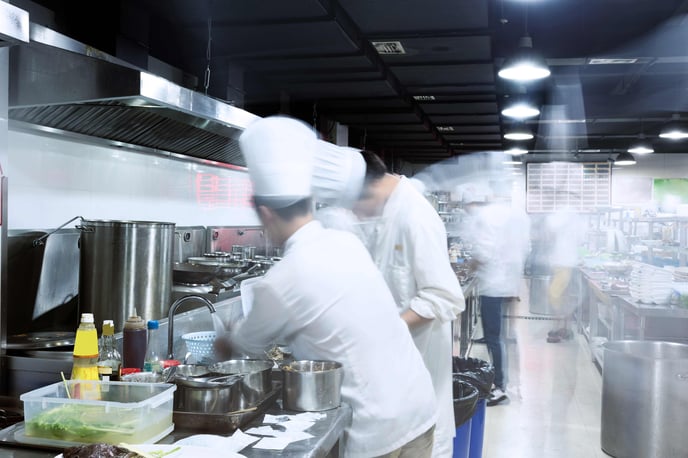
Many operators notice the symptoms before they identify the cause.
Prep takes longer. Coordination becomes more difficult. New staff require more support. Service feels increasingly fragile during peak periods.
Ask yourself:
Has mise-en-place become harder to manage?
Does the service rely heavily on specific individuals?
Do minor disruptions create larger operational consequences than they used to?
These are often signs that complexity is accumulating faster than the operation can absorb it.
Challenging to Maintain Service Consistency
Guests rarely see forecasting problems or inventory inefficiencies directly, but they do experience the downstream effects.
Ask yourself:
Are ticket times becoming less predictable?
Does execution vary more between services?
Are quality issues appearing despite unchanged standards?
When consistency becomes difficult to maintain, the underlying cause is not always training or staffing. Sometimes the operation is simply being asked to coordinate too many moving parts at once.
This hidden complexity can be seen, for example, in:
-
The number of products (SKUs) your business carries
-
Inventory turnover rates
-
The amount of waste produced
-
Stockout frequency
-
The number of labor hours gone into prep
-
How consistent the service is
When several of these factors decline simultaneously, the issue often lies with the menu itself, not just with purchasing, production, or staffing.
How to Design Menus that are Structurally Efficient and Sustainable
Enough with the challenges: Research across restaurants, cafeterias, hotels, and schools shows that there are several consistent measures in sustainable menu design that are efficient and can help reduce waste without limiting customer choice.
1. Anchor Variety in Fewer, Shared Ingredients
Instead of focusing on a “hero dish”, design the menu around a small set of core products that appear across multiple formats. This is how some of the most operationally sustainable menu systems are designed. They work because they’re built for daily execution.
The restaurant “Nolla” in Helsinki illustrates this approach in practice with their zero-waste concept. Not only does it mean “nolla,” “zero” in Finnish, but the restaurant also redesigns sourcing and ingredient usage around full utilization, adapts menus based on ingredient availability, and uses preservation and fermentation techniques to extend utilization windows.
Research among independent restaurant chefs shows that ingredient reuse across multiple dishes is one of the most common practical approaches to reducing waste while maintaining menu flexibility.
2. Standardize Flow Before Trying to Reduce Waste
Reducing waste goes hand in hand with a menu design that simplifies the production flow across purchasing, prep, and service. The fewer low-frequency items and disconnected prep systems a menu introduces, the easier it becomes to match production to real demand.
And there are other practices among operators to reduce waste. Many continuously monitor dish performance, remove underperforming items, and use specials to test demand before adding dishes to the core menu. Rather than rebuilding the menu from scratch, they make smaller adjustments over time to keep ingredient utilization, production flow, and customer demand aligned.
From an operational perspective, the question is not “How many different dishes can we offer?” but “How many different flows can our kitchen reliably run during peak hours?” Dishes that are very different for the guest can still follow nearly identical internal paths: same mise‑en‑place, same cooking line, same plating sequence.
Restaurants, such as Silo in London, for example, known as “the restaurant without a bin”, illustrate this principle in practice. They redesigned their kitchen operations to tighter production control and reduced operational friction, which is leading to a more synchronized production flow and less dependence on excess buffering or reactive adjustments during service.
3. Build Menus That Scale Operationally Across Locations
Once a concept expands beyond a single kitchen, this same structural logic becomes even more crucial. At this point, the question is no longer whether a chef “can make it work”, but whether the menu withstands across multiple teams and sites.
To build a scalable menu, you need a stable foundation behind the scenes:
-
shared core recipes,
-
standardized components,
-
and clear roles for each dish within the overall offer.
No need to reinvent the wheel for every outlet: Define which elements are fixed (base sauces, prep standards, core SKUs) and where variation is allowed (seasonal garnishes, sides, presentations).
Treat menu changes as system changes: each new dish or variation is evaluated not only on its contribution margin and popularity, but also on how it affects station load, training complexity, and the clarity of price and value in the guest’s mind.
Sustainability as an Operational Outcome
In summary, the less complex a menu is, the more sustainable it becomes, especially when it is built around a small number of principles:
-
Design menus around ingredients that can be used across multiple dishes
-
Concentrate demand instead of spreading it across too many low-volume items
-
Reduce operational variability before trying to reduce waste
-
Monitor utilization, not just sourcing
-
Treat menu changes as system changes
-
Build menu structures that can be executed consistently as the business grows
Your restaurant can succeed with a sustainable menu when environmental goals, operational realities, and commercial performance reinforce one another rather than compete.