




Scarcity marketing and exclusivity are deliberate strategies luxury brands use to transform physical goods into cultural symbols. Rooted in the Veblen effect, these tactics exploit psychological triggers, including loss aversion and social identity, to increase perceived value. The most durable luxury brands combine genuine craftsmanship with curated access, not manufactured shortage alone.
Why does a $38,000 Hermès Birkin become more desirable the harder it is to buy? On the surface, that question defies logic. Standard economic theory suggests that as prices rise, demand falls. Yet in the world of luxury goods, the opposite frequently holds true—and it is no accident.
Scarcity and exclusivity are not incidental features of high-end brands. They are deliberately, carefully orchestrated strategies that transform physical goods into cultural symbols. The mechanisms behind this transformation draw from economics, behavioral psychology, and social theory in equal measure.
This article examines those mechanisms in depth. It explores the Veblen effect that underpins the economics of luxury goods, the distinction between real and perceived scarcity, and the psychological forces that make exclusivity so compelling.
Central to this analysis is the Hermès Birkin case study as the holy grail of organized scarcity, the power of nomination-based membership, and—critically—the limits of these strategies when they are misused.
What Is the Veblen Effect in Luxury?
The Veblen effect is named after American economist Thorstein Veblen, who introduced the concept of conspicuous consumption in his 1899 work The Theory of the Leisure Class. Veblen observed that consumers purchase expensive goods not simply for their utility, but as visible signals of wealth and social standing. In luxury markets, price functions as a social marker, not merely a cost signal.
Classical economics shows that a price increase reduces demand. In luxury goods economics, it can intensify it. A Veblen good has an upward-sloping demand curve: as the price rises, so does desire. The higher the price, the stronger its function as a status symbol, and the more coveted it becomes.
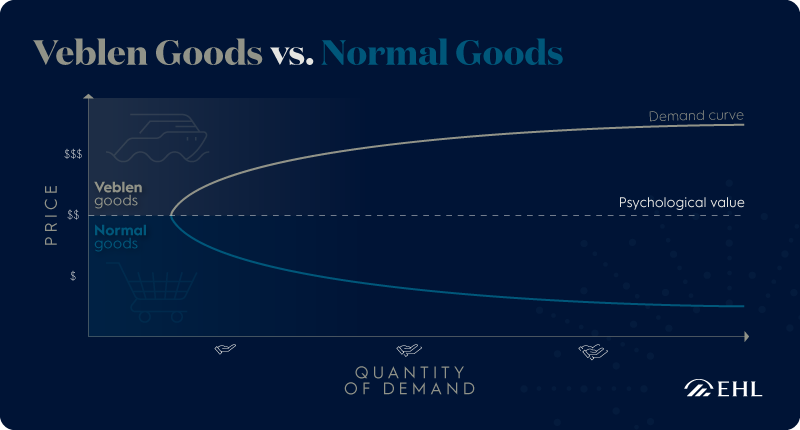
Luxury brands deliberately leverage this phenomenon. Hermès, for instance, has implemented consistent price increases—reportedly in the range of 5–15% per year across product categories—while maintaining demand that absorbs those increases without any erosion in desirability. For brands operating in this tier of luxury, a price increase is not a risk. It is, paradoxically, a signal of strength.
As Investopedia notes, when a good is perceived as difficult to purchase, affluent consumers are often willing to pay more for it. The price itself becomes a form of exclusion, and exclusion is precisely the point.
Real vs. Perceived Scarcity: Which Creates More Durable Brand Equity?
Not all scarcity is created equal. Luxury brands draw on two distinct forms, each with different implications for long-term brand value.
-
Real scarcity arises when supply is genuinely limited by artisan production capacity, rare materials, or the physical constraints of skilled craftsmanship. Niche Swiss watchmakers such as HYT and H. Moser & Cie. produce only a few hundred pieces annually. That constraint is structural, not theatrical. The rarity is inherent to the product itself.
-
Perceived scarcity is manufactured through controlled distribution, selective availability, or marketing tactics—not because production is inherently limited, but to engineer a sense of rarity. Louis Vuitton's regional allocation model and Rolex's management of waitlists for the Daytona and Submariner are clear examples. Supply could theoretically be expanded, but doing so would dilute the exclusivity signal. So it is not.
Both forms drive demand. According to McKinsey (2021), access to rare and exclusive products is a primary draw for 41% of luxury resale buyers, underscoring the depth of consumer appetite for genuine rarity.
However, real scarcity tends to create more durable brand equity and stronger long-term value appreciation. When rarity is rooted in craft and production constraints rather than distribution decisions alone, it is far harder for competitors to replicate and far harder for consumers to dismiss as marketing theater.
What Psychological Forces Make Scarcity and Exclusivity So Compelling?
The effectiveness of scarcity and exclusivity as marketing strategies is not simply a matter of economics. Three psychological mechanisms do much of the work.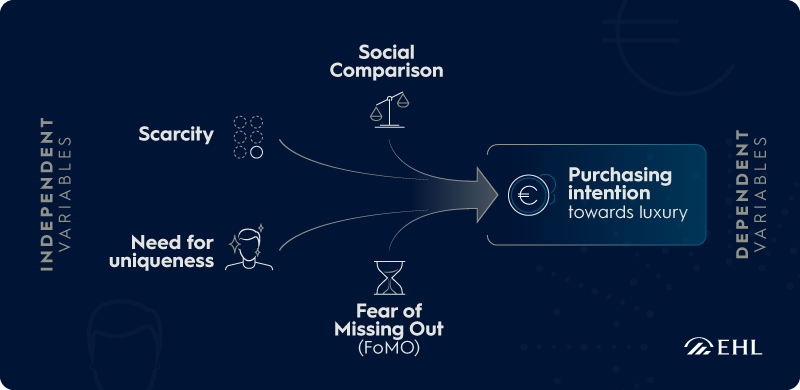
Loss aversion
Behavioral economics has long established that the fear of losing something motivates decision-making more intensely than the prospect of equivalent gain. When a rare product may become unavailable, the psychological urgency to secure it overrides rational cost-benefit analysis. The perceived loss of missing out becomes a more powerful driver than the anticipated pleasure of owning.
Social identity theory
Owning exclusive luxury goods can serve two related psychological needs: signaling distinction from others while reinforcing membership of a valued social group. Research from the Handbook of Identity Theory (Vignoles 2011) suggests that the desire to differentiate ourselves and our groups from others is a fundamental human motive.
This dynamic is also evident in conspicuous consumption, where luxury goods can act as visible signals of status and social standing. The paper Social class, social self-esteem, and conspicuous consumption (Oh 2021) found that, among people who perceived themselves as belonging to a higher social class, lower social self-esteem was associated with greater conspicuous consumption—suggesting that status-signaling purchases may also serve a compensatory role when social confidence is threatened.
Psychological reactance
When access to a product is restricted, consumers want it more. Limitations amplify perceived value. This is the mechanism behind waitlists, private viewings, and invitation-only events: restricting access generates a desire that open availability could never produce.
As the College of Wooster's Sumaiya Sarrat documented in her 2025 research, "scarcity cues drive immediate demand by increasing perceived value and competitive urgency, while exclusivity cues sustain desirability by fostering aspirational consumer identities."
Luxury brands engineer all three triggers simultaneously through limited editions, curated distribution, private client events, and tightly controlled retail environments. Critically, the exclusivity psychology operates across both product and experience. The acquisition process itself becomes part of the luxury offering.
Inside the Hermès Birkin Model: How Does Scarcity Become a Business Architecture?
No case study illustrates luxury scarcity tactics more precisely than the Hermès Birkin bag. First introduced in 1984—born from a chance encounter on an Air France flight between the actress Jane Birkin and then-CEO Jean-Louis Dumas—the Birkin has become the global benchmark for organized exclusivity.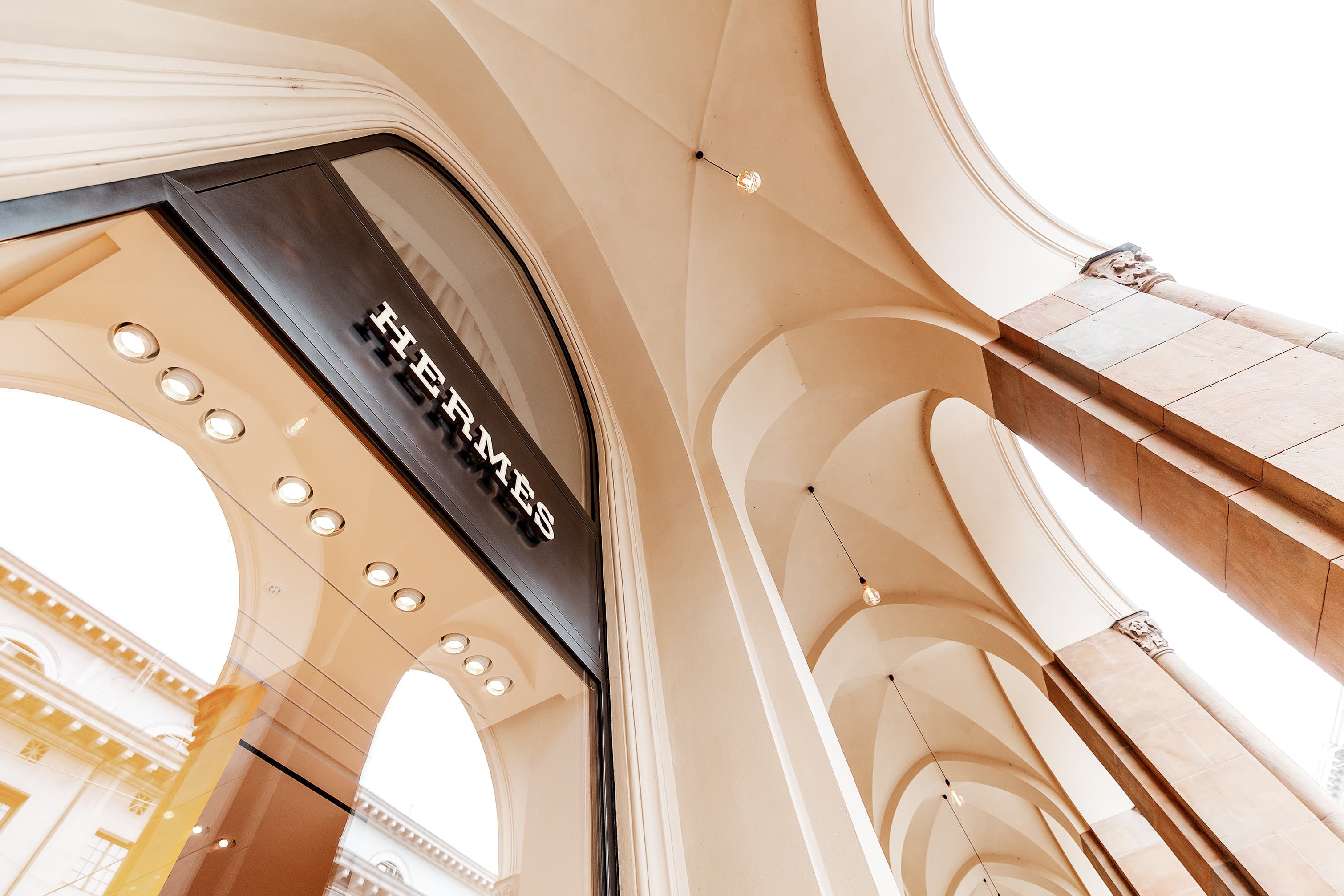
The mechanics are deliberately misunderstood. There is no official public waitlist. Instead, Birkin allocation is managed through purchase history, relationship tenure with specific sales associates, and a demonstrated commitment to the broader Hermès product ecosystem.
Customers who buy scarves, homeware, and ready-to-wear over time reportedly increase their probability of being offered a Birkin. This creates what behavioral economists classify as a sunk-cost escalation loop: customers spend across lower-margin categories for the chance to access a higher-margin aspirational product.
A standard Birkin 25 in Togo leather retails in the range of $10,000–$12,000 at a Hermès boutique. On the secondary market, comparable pieces regularly trade at significant premiums—with exotic-skin versions exceeding $50,000–$100,000 at auction.
Hermès does not profit directly from those secondary transactions. What it receives instead is something more valuable: continuous, third-party validation of its pricing power. Every auction result is proof that the brand has manufactured desire beyond what its retail price can capture.
The downstream financial results confirm the strategy. Hermès reported consolidated revenue exceeding €15 billion in fiscal year 2024 and €16 billion in 2025, with recurring operating margins in the range of 40–42%—among the highest in the luxury goods industry. The leather goods and saddlery division, which includes the Birkin and Kelly bags, consistently accounts for approximately 45–50% of total sales.
Each bag is made by a single artisan from start to finish. A production method that requires years of training and fundamentally caps output. The constraint is rooted in human skill depth, not raw material availability.
As LGT Wealth Management (2025) noted, "Scarcity alone does not guarantee allure—desire must be nurtured and maintained."
How Do Nomination-Based Membership Clubs Use Exclusivity as a Product in Itself?
Beyond physical goods, a distinct category of luxury exclusivity uses access—rather than ownership—as its central value proposition. Nomination-based private membership clubs represent the most rarefied expression of this model.
In these structures, prospective members cannot simply purchase access. Entry requires sponsorship or nomination by a current member in good standing. Price becomes secondary to social capital. The barrier is not financial—it is relational.
Soho House built its global brand on carefully managing the composition of its membership base to protect its creative-industry positioning. Quintessentially, the ultra-high-net-worth lifestyle concierge network operates on a referral-and-vetting model. Private banking institutions increasingly deploy tiered access structures in which the highest level of service is never publicly advertised; it can only be offered.
The American Express Centurion Card operates on a similar logic. Invitation-only, with an annual fee that reflects its exclusivity, the card's desirability derives less from its specific benefits than from the fact that it cannot be applied for. Access must be earned through demonstrated spending behavior over time.
The psychological power of this model is significant. Money alone cannot unlock membership, and that fact makes membership exponentially more desirable. The social endorsement implied by a nomination carries a symbolic weight that no marketing campaign can replicate. Nomination-based systems create communities of genuine belonging, which research indicates is a stronger driver of long-term loyalty than product ownership alone.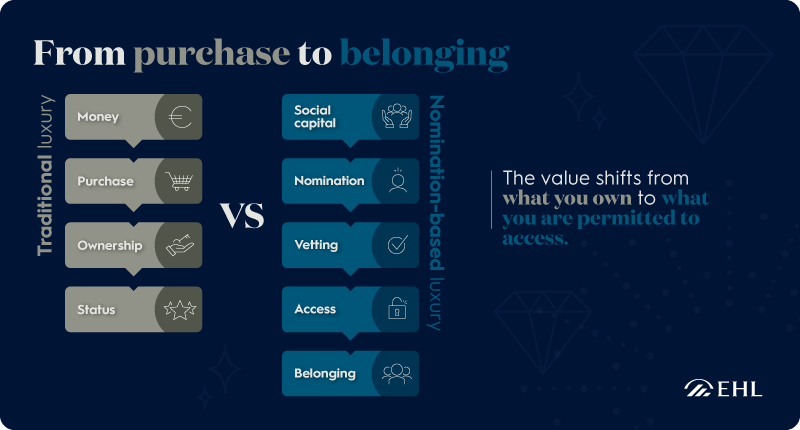
When Does Scarcity Backfire? The Risks Luxury Brands Must Actively Manage
Scarcity strategies are not without risk. Overuse or mismanagement can undermine the very equity they are designed to build.
Perceived inauthenticity
If a brand repeatedly launches "limited" collections that are later replenished, the scarcity narrative loses credibility. Sophisticated consumers identify the gap between the exclusivity promise and the commercial reality and discount the brand accordingly.
The same principle applies to brand visibility. As luxury brand strategist Simon Woolford (2025) puts it: "Without discipline, ubiquity becomes a form of erosion."
Generational tension
Younger luxury consumers—particularly Millennials and Generation Z—are increasingly skeptical of manufactured exclusivity. This cohort tends to favor brands whose rarity is rooted in genuine craft, sustainability, or cultural authenticity rather than distribution control. Brands that rely on artificial restrictions without an underlying substance face mounting credibility challenges with this segment.
Legal exposure
Scarcity claims can also create legal exposure. Writing about EU and Spanish consumer protection law, Adrián Fernández de Pedro of Hogan Lovells (2026) argues that when scarcity is used as a commercial argument, it should be genuine, documented, and consistently applied.
EU consumer law prohibits misleading claims about product availability, including falsely stating that an offer is available only for a very limited time to pressure consumers into an immediate decision. For luxury brands, presenting a collection as highly limited before releasing additional units without clear disclosure could therefore raise questions about whether consumers have been given accurate, non-misleading information.
For luxury brands operating in the EU, this adds a regulatory dimension to scarcity strategy. Production limits and scarcity claims need to be substantiated and communicated accurately across channels. As Fernández de Pedro concludes, scarcity “is both a strategic asset and a legal responsibility.”
When Less Creates More Value
For leaders managing brands built on experience and perceived value, scarcity presents a strategic tension: how do you pursue growth without diluting what makes an offer desirable in the first place? In luxury, craft constraints, selective access, price signaling, and controlled availability can all shape perceived value, while artificial scarcity without a convincing rationale risks doing the opposite.
The principles also have relevance beyond traditional luxury. Organizations competing on experience and perceived value—from premium healthcare to hospitality and lifestyle services—can think more deliberately about who gets access, how the acquisition journey shapes anticipation, and when greater availability might actually diminish what makes an offer desirable.
For leaders accustomed to treating unmet demand as a problem to solve, that requires a different mindset. Growth does not always mean maximizing availability. In markets where distinction matters, having the bravery to not satisfy demand can be part of what sustains demand in the first place.




.jpeg?width=403&height=266&name=luxury-retail%20(1).jpeg)