





When contemplating a career in hospitality and tourism management, or hotel management, knowing what will make your hotel stand out is key. One way to convince target travelers to book with you is by obtaining your desired hotel star rating.
But how do you go about that?
Read on as we discuss what determines how many stars a hotel has, the different rating systems around the world, and how to influence them.
How Are Hotels Rated?
There is no one global hotel star rating system. Depending on the country your hotel is located in, it can receive a rating from a private organization, a national or regional institute, or the government. On top of that, booking sites like Booking.com and TripAdvisor often have their own rating system as well.
This can make things confusing for both hotel managers and travelers, as a three-star hotel in Europe might deliver a different experience compared to a three-star hotel in Asia. It's thus crucial for a hotel manager to know which requirements must be fulfilled to get a certain rating in the hotel's country of operation.
On top of that, each country or organization reviews its rating system at different intervals. The UK, for example, reassesses its system every five years, while the American Forbes Travel Guide reviews its classifications annually. This is important to know if you're working towards a better rating.
Luckily, most reputable organizations and governments do follow a system that rates hotels on a scale of one to five, with one indicating a very basic hotel and five a highly luxurious one.
What about no-star and seven-star hotels?
Hotels that don't have a star might be hotels that don't even meet the basic requirements to receive one star, but more often than not, they are hotels that have opted not to be rated. This could be the case for hotels offering a unique experience that's hard to judge using the traditional rating criteria.
As far as six or seven-star hotels go, they don't officially exist. Some hotels self-classify like this to point to the extreme luxury they offer but there is no reputable hotel star rating system that goes beyond five stars.
That being said, there are rating bodies that have a special category for luxury stays. The French Tourism Development Agency, for example, has the title "Palace" for extraordinarily luxurious hotels.
The Rating Process
Hotels usually don't automatically receive a star rating. They need to apply for it with the relevant institution and, oftentimes, pay a fee for the assessment.
Once an application has been submitted, the rating organization evaluates the hotel based on a list of criteria. It'll also send a reviewer to stay at the hotel as a mystery shopper and determine the quality of the accommodation, amenities, and services. The combination of the initial assessment and the reviewer's report makes up the rating a hotel gets.
What about guest reviews?
Reviews don't directly impact star ratings, but they can play a big role in the traveler's decision-making process.
Hotel Star Ratings Around the World
For the biggest impact on your bookings and brand reputation, go after your desired star rating with the most popular and respected rating organizations in your country of operation.
Here are a few independent organizations you should know about:
- USA:
- The American Automobile Association (AAA) uses a Diamond rating system that goes from "approved" to three and four stars, up to five stars.
- Forbes Travel Guide: focused on luxury hotels. Tends to only rate three, four, and five-star hotels.
- Europe: the European Hotel Stars Union (EHSU) covers hotel star ratings for 21 countries.
- Australia: Star Ratings Australia uses more than 200 criteria to classify travel accommodation.
And here are a few countries where governmental bodies assign hotel stars, sometimes in collaboration with independent organizations:
- UK: the AA Hotel Guide and tourism board VisitEngland use the same criteria and display their star ratings on a joint website.
- France: French tourism development agency Atout France sets the criteria for hotel star ratings.
- Japan: the Japan Tourism Bureau (JTB) uses a one-to-five-star system
New Zealand: rating body Qualmark is part of Tourism New Zealand - India: the Ministry of Tourism has a Hotel and Restaurant Association Classification Committee (HRACC) that not only has a one-to-five-star system, but also categories for Deluxe five-star hotels and heritage hotels.
- South Africa: the Tourism Grading Council of South Africa (TGCSA) is a business unit of the Department of Tourism and uses a five-star rating system.
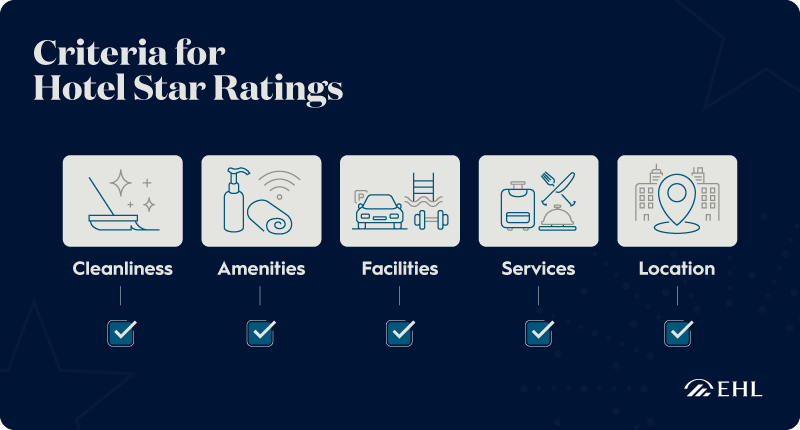
Even though there are many different bodies assigning stars, they typically all take the following rating criteria into account:
- Cleanliness: the hotel's hygiene standards and how clean the rooms and common areas are.
- Amenities: the availability, variety, and quality of in-room amenities, such as water kettles, toiletries, air conditioning, and bathrobes.
- Facilities: the presence and quality of facilities like pools, fitness centers, Wi-Fi, and on-site restaurants, but also room size and furniture quality.
- Services: the quality and types of services provided to hotel guests. Examples include room service, front desk service, and valet service.
- Location: proximity to popular sights, accessibility, and overall appeal of the location.
For a transparent overview of how a rating body assigns hotel stars, check out the AA's Quality Standards.
Keeping in mind that there is no global standardized hotel star rating system, one can expect the following of hotels with one to five stars:
- One-star hotels: Very basic accommodations with few in-room amenities, limited-hours front desk service, and housekeeping performed only between guest stays.
- Two-star hotels: Basic accommodation with a bit more comfort and some in-room amenities. Two-star hotels may offer limited services such as daily cleaning or breakfast. Facilities at these hotels are limited.
- Three-star hotels: More comfortable and better-equipped rooms with decent-quality bedding and in-room amenities. Three-star hotels also offer more facilities, such as a hotel bar, a business center, and/or a fitness center. Services may include laundry and room service.
- Four-star hotels: Luxurious rooms with high-quality furniture and lots of amenities. A stay at a four-star hotel means a full-service experience with the use of facilities such as signature spas, infinity pools, and top-rated restaurants.
- Five-star hotels: At five-star hotels, everything is the best it can be. From high-end furniture to valet and butler service, childcare, designer decorations, on-site dining options, and spacious lodgings that often include hot tubs and separate lounge areas.
The Importance of Hotel Star Ratings
Stars signal to travelers what they can expect in terms of quality, services, and, although highly dependent on the destination, room fees. But that's not all. Aside from giving your hotel a certain status and travelers something to filter for, here's what a star rating can help you with.
Attract the Right Audience
Travelers who know what to expect from a certain star rating filter for their desired rating when planning a trip, either on booking platforms or through their travel agent. While a budget traveler is more likely to filter for price, someone looking for an above-basic experience is likely to look for a certain star rating.
Obtaining the rating that matches the type of guest you're looking to attract increases your chances of reaching your target customers.
On top of that, someone who consciously books a three-star hotel is less likely to expect a five-star experience than someone who has, in their opinion, simply paid "a lot" for a stay. In this sense, your star rating also helps manage guest expectations.
Charge Higher Rates
A higher star rating usually justifies charging higher rates, though this comes with some caveats, as the costs of running a luxury hotel are also significantly higher than those of running a budget hostel, for example.
In the end, what matters is whether the hotel's balance looks healthy with stable or growing revenue and net profit.
Stay on Your Toes
To obtain or maintain a certain star rating, the hotel needs to deliver quality consistently. That means performing renovations when necessary, offering ongoing training to staff, and performing internal quality checks.
Knowing you'll receive an inspection at some point in the future can act as extra motivation to maintain a certain standard.
Gain Industrial Recognition
Especially for four and five-star hotels, their rating comes with industry recognition, and a star bump or confirmation often results in positive publicity. It's a way to stand out both among peers and among travelers.
How to Increase Your Hotel's Star Rating

It would be easy to say that to improve your rating, you need to improve your rooms, your service quality, your cleanliness, and provide more amenities, but that would ignore the reality that you have budget limitations and daily operations to uphold.
Instead, study the criteria of the rating system your hotel falls under to identify which changes are most likely to boost your score. Combine that knowledge with the feedback guests leave about their stay, and an honest evaluation of the quality you offer.
- Do guest reviews mention dated bedding? Perhaps it's time to invest in new linen.
- Do you avoid having breakfast at the hotel yourself? Perhaps it's time to spruce up the menu or do something about the acoustics in the breakfast room.
It's also a good idea to compare the services and amenities of your hotel with those of competitors who have a higher rating and analyze which upgrades you can realistically implement.
Lastly, obtaining a higher rating is not a one-time event. You never know when an anonymous reviewer is going to show up, and once you've received an extra star, you need to make continuous efforts to keep it. That means:
- investing in ongoing staff training.
- staying on top of evolutions in the market (focus on sustainability, implementing new technology, …)
- performing regular quality control.
Pursuading the Traveler, Regardless of Your Star Rating
While hotel star ratings are important to some travelers, they aren't everything. Not every traveler cares about the same things, and their needs can differ from trip to trip. Someone who likes to stay at centrally located hotels with a bar while on holiday might just look for a basic bed close to a certain venue when visiting a trade fair.
Others are members of a loyalty program and, therefore, more likely to book with hotels that are part of that program.
And when it comes to the lower and mid-range segments, travelers tend to highly value reviews on booking platforms such as Kayak, Orbitz, TripAdvisor, and Booking.com. According to TripAvisor, no less than 81% of its users always or frequently read online reviews before deciding on a place to stay.
It's not uncommon for a three-star hotel to get a five-star rating on a booking platform simply because the stay exceeded many travelers' expectations.
Even though guest reviews don't directly influence how many stars you get, they can heavily impact your revenue—both positively and negatively.
So don't put all of your eggs on one star and build an overall attractive hotel brand by:
- incentivizing guest reviews.
- commenting kindly on reviews.
- making sure staff answers phone calls cordially.
- building a recognizable presence on social media.
- charging correct rates.
- optimizing your website.
Take Control of Your Hotel Star Rating
With different rating systems for different countries, it's important to study the hotel star rating requirements your hotel must meet to obtain its desired rating. Cleanliness, service, amenities, facilities, and location are all factors that representatives of rating organizations will take into account when anonymously staying with you.
Gaining the correct star rating can help attract the right type of traveler and might even allow you to charge higher rates, but it also comes with responsibility. To maintain your rating, you need to provide the same quality of service consistently, regardless of whether you're running a budget motel, a boutique hotel, or a five-star resort.
And while a good rating can positively impact your bookings, you don't need to rely solely on your stars. There are plenty of other actions you can take to show travelers why they should choose your hotel for their next trip.