


A study published in the NPRC Journal of Multidisciplinary Research found that 50.8% of hotel guests felt that cultural differences influenced their stay and 75% of the participants felt that hotels should increase their cultural understanding (Vol. 2, Issue 7, July, 2025).
It's not hard to see these sentiments extend to the rest of the hospitality industry.
Operating with cultural awareness is crucial but not always easy. The first step in managing cultural diversity among your guests is learning about the many cultural differences between the company you operate in and the guests you receive, as well as the cultural backgrounds of your staff and your guests.
What Are Cultural Differences?
Cultural differences are the beliefs, values, symbols, and behaviors that distinguish one culture from another. In hospitality, culture often refers to the region, country, or religion someone is from, but it can also refer to social, artistic, or other groups.
When talking about cultural differences, it's important to distinguish between generalizations and stereotypes. As The Western Journal of Medicine states: " A stereotype is an ending point, and no effort is then made to ascertain whether it is appropriate to apply it to the person in question. A generalization, on the other hand, serves as a starting point."
An example would be:
- Stereotype: "Indian people are conflict-avoidant."
- Generalization: "Indian people tend to be conflict-avoidant. I wonder if there's a less direct way to check if this Indian couple's stay is according to their expectations."
The Importance of Understanding Cultural Differences for Hospitality
How customers perceive the customer service you offer highly impacts their experience. It's therefore important to be aware of where cultural differences may show up during your guests' experiences.
Does that mean you need to adapt to each guest's cultural customs? Not necessarily. But it is important to know how your degree of adaptation affects customer satisfaction and whether you risk alienating your target audience by being too rigid.
Standardized processes and offerings may increase operational efficiency, but they don't always leave room for personalization. Those working for chains and franchises know the balance they need to strike between following brand guidelines and adapting to the local market.
Not adapting to cultural differences can also be a brand strategy. A lot of Westerners, for example, enjoy feeling like they're traveling a bit when going to an Asian or African restaurant. They expect a certain type of interior, and all of a sudden, it becomes okay to use their hands or bread instead of a knife and fork.
The degree to which you adapt your services needs to be a conscious choice, and you can only make that when you're well aware of the cultural differences you might face.
We'll go deeper into these further down this article, but here are already some of the issues that can arise:
- Guests who feel that they're not being addressed in a respectful way.
- Buffets or menus that don't cater to certain dietary restrictions.
- Events not starting on time.
Cultural Differences Examples
While hard when you're catering to an international audience, it's good to acquaint yourself and your staff with the many types of cultural differences there can be between them, the guests, and the way your business operates as a whole.
Did you know, for example, that in China and Japan, the number "four" is considered bad luck? That's because the word for "four" is pronounced similarly to the word for "death". Now that you do, you might want to avoid putting people from those cultures in a room that contains the number four, or assign them to group #4 during a team-building activity.
Below are more examples of cultural differences. You can memorize these and think of how these types of differences could show up with the guests that visit you.
Cultural Differences in Communication
Communication in a clear, effective, and respectful way is already hard between people from the same culture who speak the same native language. Throw in some cultural differences and language barriers, and you can see how easily things could turn sour.
Someone from the US or the Netherlands, where it's okay to be very direct, could easily offend someone from a culture that appreciates a more roundabout way of addressing things. And how do you translate the respect shown by addressing someone as usted in European Spanish, você in European Portuguese, or vous in French when you only have "you" in English?
Being aware of the communication styles of different cultures can help you communicate with your guests in a more effective and satisfactory way.
How you perform a service and who you perform it for is its own form of non-verbal communication. In some cultures, it's customary to first serve the elders during a meal, whereas in others, women come first, and in yet others, it's the person with the highest status.
You might think that you'll at least be able to see in someone's expression whether they're enjoying their experience, but not even that is the case. Some, mostly East Asian cultures, consider public emotional expression inappropriate, whereas some Southern European countries are known for their expressiveness.
Cultural Differences in Greetings

The safest way for a hospitality service provider to greet someone is verbally. While some customers from Asian cultures would appreciate a bow, Western handshakes are generally reserved for business encounters or saying hi at the start of other types of meetings. People won't expect a receptionist to start their check-in with a handshake.
Cultural Differences in Personal Space
Personal space is barely a thing in the Middle East or India, while Western Europeans and people from North America easily get uncomfortable when someone stands too close to them. If you stand too far away from a guest, you may seem standoffish, but come too close, and they might see you as aggressive.
In this case, it's a good idea to mirror: Suggest that staff respect the distance the guest chooses. That might mean letting them take a step back or come closer, as long as their chosen distance doesn't feel inappropriately close to you.
This difference in personal space perception extends to other things, too. Just think of how the Brits are famous for queueing, while you'd never get your turn if you queued in some other countries.
Cultural Differences in Body Language
Eye contact and hand gestures are two components of body language that can be perceived very differently across cultures. Make the "okay" sign to someone from Turkey, and they might think you're calling them an asshole. That's not what you want to happen when you simply want to signal to someone that their late check-out has been arranged.
Hand gestures are best avoided overall, as they can mean so many different things in different countries. Even when pointing in a direction, it's best to use your whole hand and a finger.
When it comes to eye contact, the middle road is the safest. Unless you're sure what's customary for someone, shift between maintaining eye contact and looking somewhere else.
Cultural Food Differences
Cultural food differences comprise not just what we eat, but also how we eat it. The owners of many types of Asian restaurants have long learned that Westerners love their food, but usually not how spicy it is, and so asking for a spicy dish at an Indian restaurant in Canada, for example, will get you something very different than asking for a spicy dish in Mumbai.
Grabbing food from one big pot or dish, or eating "family style", is also more common in some cultures than it is for everyone at the table to order their own meal.
Even when hosting business dinners or events, it's good to know about cultural seating rules. In some cultures, seat placement depends on the status and relationships of the guests, and there will often be a "head of the table," while in other cultures, round tables signal equality.
Dietary restrictions
When speaking of cultural differences, guests' dietary restrictions are most often influenced by their religion (no pork for muslim guests, no beef for Hindus, etc.).
These are different but no less important than guests who can't eat certain things due to health reasons or ethical considerations (vegans, vegetarians, …).
Consumption
Toasting is done differently in different countries as well. In some places, it's bad luck if you don't look in the eyes of the person you're toasting with. In others, it's bad luck if you toast with anything but strong alcohol. And in Georgia (the country), they toast with beer to wish someone bad luck.
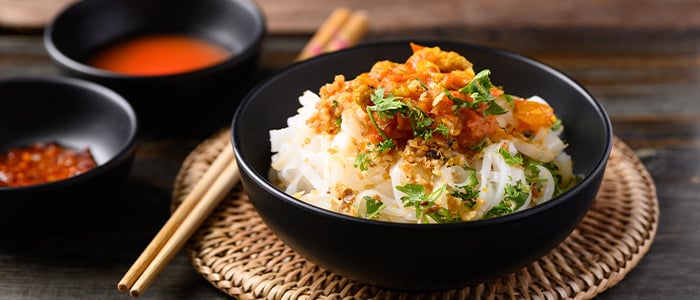
Slurping is considered rude in many Western countries, while it's indicative of enjoying your meal in Japan. Indians and Moroccans eat with their right hand while Westerners use a fork and a knife, and Thai only use a fork to scoop their food onto the spoon with which they eat.
And say you put a Japanese dish on your menu. Presenting it together with chopsticks is a nice touch even for Western travelers, but make sure not to stick the chopsticks upright into rice as a way of decorating the meal. Doing so would make them resemble an offering at a funerary rite.
Cultural customers around the presentation and serving of food don't just matter for the guests at your restaurant. They also matter when you're creating content to promote your business. You don't want to put anyone off before they've even had the chance to visit you.
Meal timing
When people eat matters too, as you may want to adapt your restaurant's opening times to the guests that frequent it. People from Northern Europe tend to have dinner quite early in the day, while only foreigners have dinner before 10 p.m. in Spain, for example. And in Mediterranean countries, people often spend hours at lunch. If they are part of your target audience, your lunchtime hours or breaks should reflect that.
Cultural Differences in Punctuality and Efficiency
Most of us know about German punctuality in contrast with, for example, Spanish flexibility. Different cultures tend to follow one of two time orientations. Monochronic cultures view time as linear and tend to perform one task after the other in a structured way.
Polychronic cultures see time as cyclical or circular, with the present holding space for multiple things at once.
In monochronic cultures like the German, Swiss, and US ones, punctuality is important, and being late or not sticking to a schedule is seen as disrespectful and unprofessional. Polychronic cultures like the Italian, Brazilian, and Congolese ones, however, are more relaxed and flexible when it comes to timing.
This can affect how you plan events, especially international ones. You may want to start at set times to please those from monochronic cultures, while announcing that doors open and people may arrive to settle in and connect half an hour earlier to give those from polychronic cultures some flexibility.
Cultural Differences Related to Gender Roles and Sexual Orientation

There are many differences around the world when it comes to gender equality and roles. You might think that it's sufficient for your staff not to look surprised when a man answers for his wife, but how will you handle it when a woman wants a massage from another woman and you only have a male masseuse on staff?
It's important to think about the different situations in which cultural beliefs around gender roles could come up and decide on "if this, then that" actions so personnel can act swiftly in the moment.
It's also a good idea ot have a clear policy around the equal treatment of guests with different sexual orientations. You may have people among your personnel who come from cultures where it's still frowned upon when two men check into the same room. While you can't force another belief system on your staff, you can train them to keep their beliefs to themselves and not have them affect their work.
If they're not able to do that, they might not be a cultural fit.
Cultural Differences in Gift Giving and Tipping
Ah, tipping. A custom that so often causes confusion.
In the US, tipping is, culturally speaking, compulsory, and service staff wouldn't earn enough without receiving tips. In Western Europe, however, hospitality staff usually does earn a living wage, and while tips are much appreciated and sometimes even expected, there's a lot more freedom for guests to decide if they tip and how much.
It's good to make personnel aware that the tipping culture of your guests may be different than that of the country you're based in, and that not all guests will tip in the same way.
Turning the roles around, you want to be aware of gifts that are considered appropriate in different cultures. This can come in handy when you offer a welcome gift, need to make up for a service issue, or want to do something extra for a guest's special occasion.
In China, for example, giving white flowers is offensive because those colors symbolize death, and handkerchiefs are associated with saying (permanent) goodbyes.
Cultural Differences in Marketing
We already saw how a lack of awareness of cultural differences can seep through in content creation. When done well, the target audience of a campaign won't notice that you're culturally aware because they won't notice anything's off.
Unless, of course, you decide to make your adaptation to local customs the core of the campaign. A good example is how McDonald's added several vegetarian options to its menu in India and, as such, managed to increase brand loyalty in a largely vegetarian market.
Compare that to a 2018 video ad in which Dolce & Gabbana's "humorous" way of showing an Asian model clumsily eating Italian food with chopsticks managed to unleash a Chinese boycott of the brand.
Marketing can also help guests know what to expect and is a great tool for putting off the type of customer that isn't a good fit for your business.
A Note of Caution
Being able to offer guests a personalized experience by taking their cultural customs into account can be a great way to make a positive impact. At the same time, someone with a Asian name may have been born and raised in the Netherlands, and someone with a Western name might have converted to Islam.
It's best not to assume and to offer a personalized service based on the guest's needs and preferences rather than what you think their cultural background may be.
Don't Let Cultural Differences Harm the Guest Experience
Hospitality businesses often receive guests from a range of cultures. If you're staff isn't aware of the cultural differences that could show up, they might be caught off guard and respond in a way that is amusing to the guest at best, offensive at worst.
Use the examples in this article and research the customs of your guests to train personnel and inform your marketing campaigns. The latter are both a tool to demonstrate cultural sensitivity and a way to show prospects what they can expect when they book a stay, a table, an experience, or an event ticket with you.