




At EHL, we operate professional kitchens across fine-dining, catering, and educational environments. The recommendations in this guide are based on the experience of chefs and instructors who work with these tools daily. What follows is a practical guide to the professional kitchen utensils our chefs rely on most, including what to look for when selecting them and why they matter in a professional kitchen.
The Eight Essential Professional Kitchen Utensils
Ask a professional chef what separates a functional kitchen from an exceptional one, and the answer rarely begins with the menu. It begins with the tools. Professional kitchen utensils are not a question of preference. They are a matter of performance, safety, and consistency, service after service.
-
Chef's knife: the most-used tool in any kitchen brigade. Blade steel, balance, and full tang construction are the non-negotiable criteria.
-
Kitchen shears: handle tasks no knife or scissors can, breaking down whole poultry, trimming fish fins, or spatchcocking. But it must be easy to clean for hygiene compliance.
-
Precision tongs: spring tension and tip geometry determine control at every station, from mise en place to final plating.
-
Spatulas: professional kitchens maintain at least three types (offset, silicone, and fish), each with a distinct blade geometry for a specific task.
-
Microplane and fine graters: they cut cleanly through cell walls and release maximum aroma without bruising.
-
Plating tweezers: a foundational skill at EHL from day one. Flat, curved, and angled tips each serve a different plating scenario.
-
Whisks: balloon for aeration, French for sauces and roux, flat for deglazing, wire gauge and handle material matter at professional volumes.
-
Ladles and portioning tools: ladle sizing is a P&L decision, not a culinary one. Stainless steel with interior volume markings is the standard.
Why Tool Quality Defines Kitchen Performance
Professional kitchen tools determine:
-
Speed and throughput
-
Consistency
-
Food safety and HACCP compliance
-
Ergonomics and injury prevention
-
Return on investment
A worn or imprecise tool slows a team, creates compliance risk, and increases long-term cost. Quality tools pay for themselves through performance and durability.
Speed and Throughput
At EHL, kitchens serve thousands of plates daily across multiple outlets. Every second counts. High-quality tools are faster tools, not because they move faster, but because they perform predictably, removing friction from every gesture.
Consistency
Precision tools produce uniform results. The same cut, the same portion, the same texture, every time. This is non-negotiable in fine dining for both presentation and cooking time, as much as in high-volume kitchens, where yield consistency directly affects food cost.
Food Safety and HACCP Compliance
Worn, cracked, or low-quality utensils are a hygiene liability. They harbor bacteria in micro-fissures, are harder to sanitize, and can shed material into food. Cuts and lacerations are among the most common injuries in commercial kitchen environments.
Ergonomics and Injury Prevention
Repetitive strain injuries, wrist tendinitis, carpal tunnel, and shoulder fatigue are hazards in professional kitchens. Handle geometry, weight distribution, and grip surface all affect how much strain a chef accumulates across a full service.
Return on Investment
A cheap tool that lasts one season costs more than a professional-grade tool that lasts a decade. This is the total cost of ownership argument: operational decisions, including equipment choices, are financial decisions.
A Chef's Checklist
Professional kitchen utensils fall into eight essential categories:
Chef's Knife: The Non-Negotiable Foundation
What is a chef’s knife?
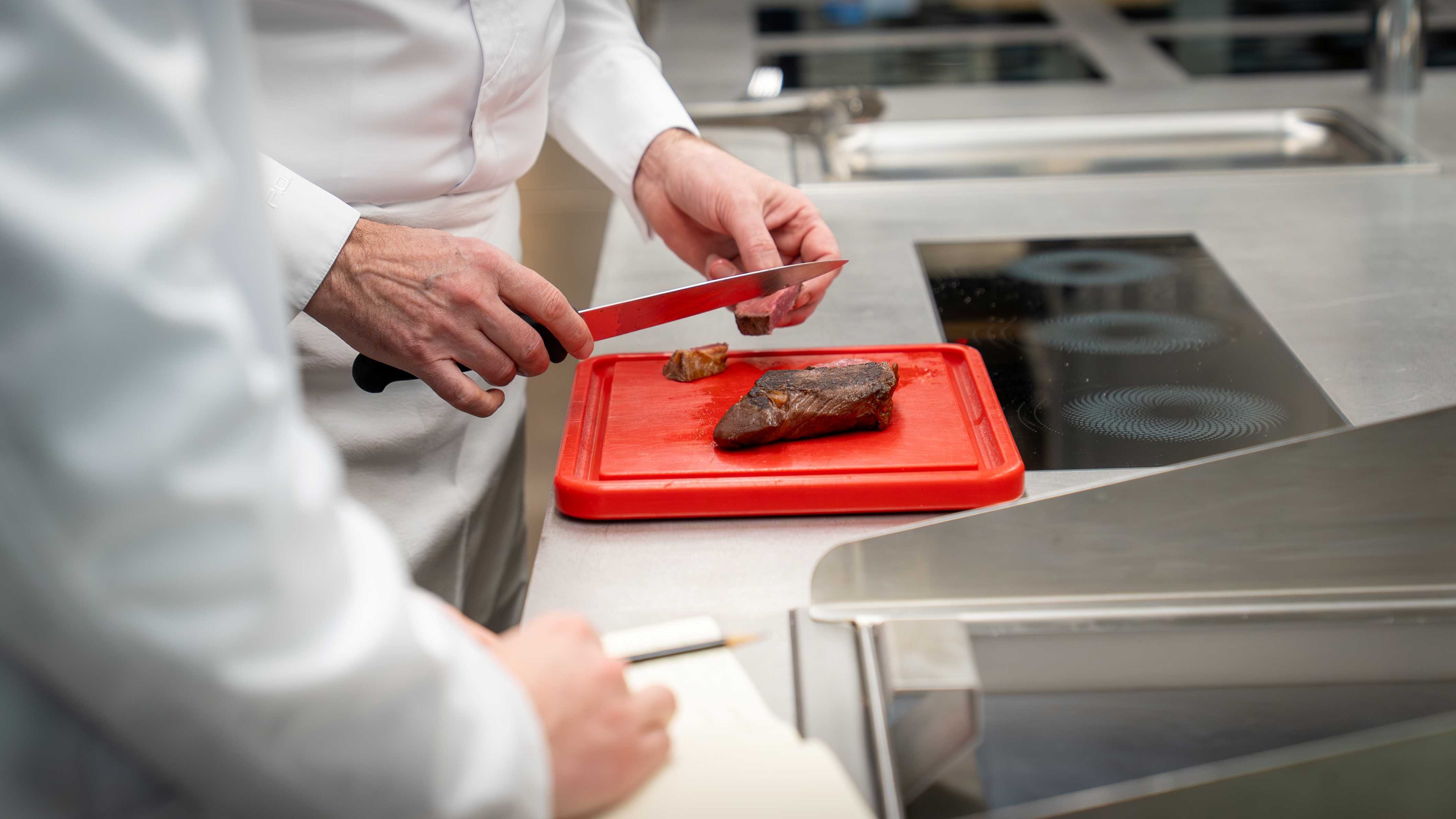
A chef's knife is a multipurpose bladed kitchen tool, typically 20-25cm long, used for the majority of cutting in a professional kitchen: chopping, slicing, dicing, mincing, and breaking down proteins. It is the most used tool in any kitchen brigade.
What to look for in a professional chef’s knife?
-
High-carbon stainless blade: Professional standard: it combines edge retention with corrosion resistance
-
Carbon steel blade: Sharpens more easily but corrodes on contact with salt and acidic ingredients
- Ceramic blade: Holds exceptionally fine edge and resists odor transfer (great for fruit and vegetables), but chips on bone and cannot be resharpened in a standard kitchen.
Balance should feel immediate. The point of equilibrium between blade and handle must feel natural from the first stroke, not something you adapt to over service hours.
Full tang construction, where the blade steel extends the full length of the handle, ensures the knife holds together under the repetitive load of a full service without flex or loosening at the join.
How to maintain a chef’s knife?
Honing and sharpening are different operations:
-
Honing realigns the edge without removing material and belongs at the start of every service.
-
Sharpening removes metal to restore the edge geometry and should happen monthly or seasonally, depending on use.
A dull knife demands more force, increases slip risk, and delivers inconsistent cuts.
Professional Kitchen Shears: The Most Underrated Tool
Professional kitchen shears are a scissor-format cutting tool engineered for food preparation, distinguished from household scissors by their blade-to-handle ratio (which multiplies cutting force), surgical-grade stainless steel construction, and full disassembly for hygiene compliance. Their range of use is broader than most cooks realize:
-
Breaking down whole poultry
- Spatchcocking birds
-
Trimming fins from whole fish
-
Snipping fresh herbs directly over a plate
-
Cutting parchment and cling film
-
Handling tougher prep tasks where scissors simply lack the mechanical advantage
The problem with standard kitchen scissors is structural. They flex under load, their pivot corrodes over time, and their two-blade design makes sanitization nearly impossible in a commercial kitchen context. For a professional environment, that is a food safety failure.
What to look for in professional kitchen shears?
Handle ergonomics designed for different hand sizes, including left-handed cooks, and a blade geometry that delivers force efficiently without tearing the product.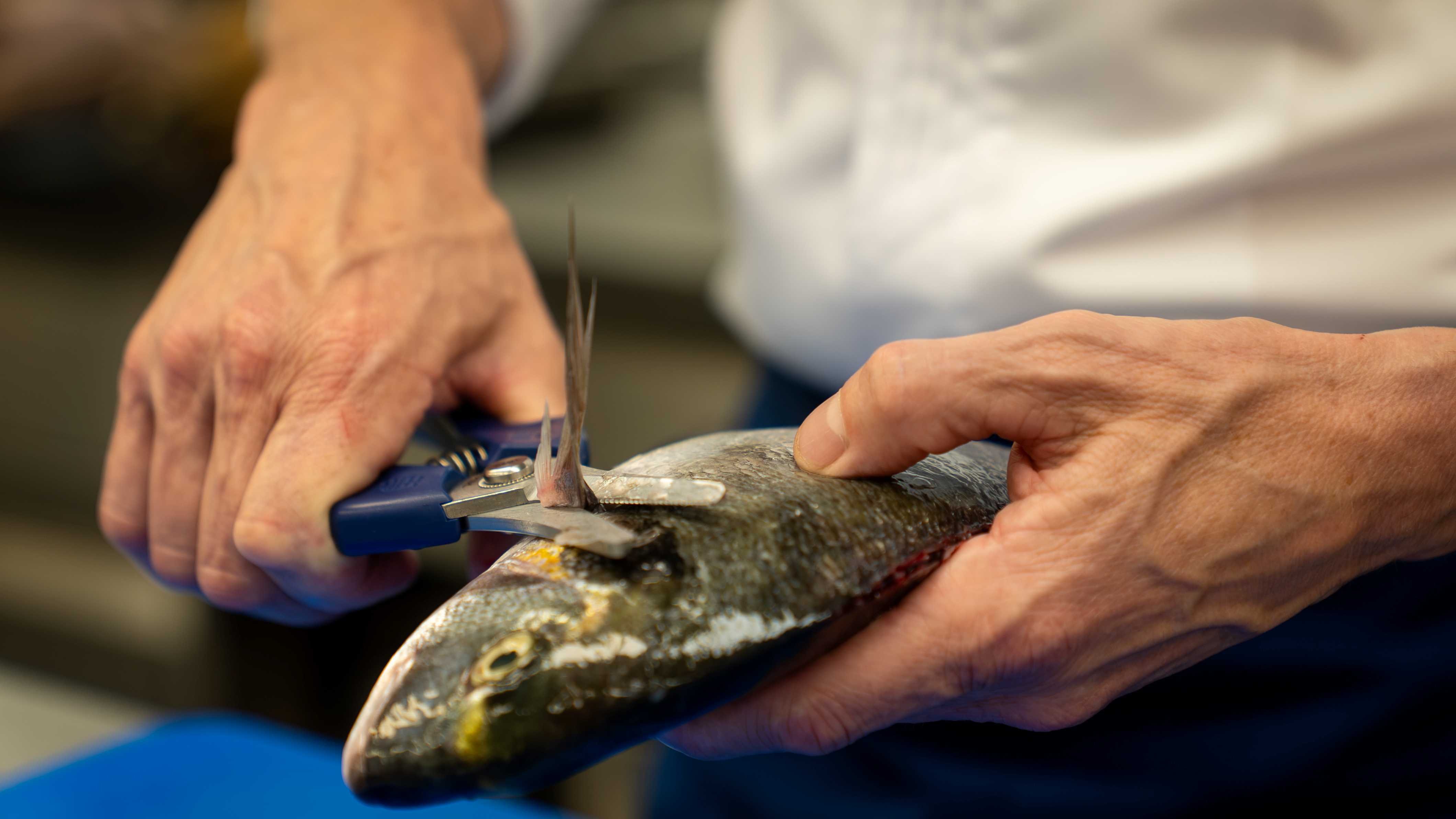
Precision Tongs: Control at Every Station
Tongs are a hinged gripping tool used to handle, turn, and plate food without direct hand contact. In a professional kitchen, they are in use from first mise en place to final plating, and are available in locking and non-locking versions, with silicone or metal tips depending on the task.
What to look for in precision tongs?
Spring tension and tip precision are the non-negotiable specifications. Tongs that open too wide require excess finger effort across a full service. Tongs with imprecise tips cannot place a microgreen or retrieve a scallop from a hot pan with the control that fine-dining demands. The two meaningful choices are tip material and locking mechanism:
-
Silicone tips protect delicate surfaces and non-stick cookware
-
Scalloped metal tips provide grip on heavier proteins and allow precise plating work
-
Non-locking tongs offer faster one-handed operation during service
-
Locking tongs are preferable for storage and transport
Offset and Heat-Resistant Spatulas
A spatula is a flat, flexible kitchen tool used to lift, spread, fold, and scrape. Professional kitchens use several types simultaneously. Each has a distinct blade geometry suited to a specific set of tasks:
-
The offset spatula for pastry and plating work
-
The silicone spatula for cooking and folding
-
The fish spatula for handling delicate proteins
No single spatula geometry serves all scenarios. Fine-dining kitchens maintain a minimum of three types at each station, and the distinction between them is functional, not redundant:
-
The offset spatula angles the blade away from the handle, allowing a chef to slide cleanly under delicate items, lift without tearing, and spread glazes or purées with precision.
-
The silicone spatula is the cooking tool: food-grade silicone rated to 220°C or above, built for folding, stirring, and scraping without damaging cookware surfaces.
What to look for in spatulas?
From a compliance standpoint, verify that any spatula used in commercial food service is NSF-certified. NSF-certified utensils meet the sanitation and material safety standards required by most health codes.
Microplane and Fine Graters
What are microplane and fine graters?
A microplane is a fine-toothed grating tool used to reduce aromatics, citrus zest, hard cheese, and spices into a light, uniform texture directly over a dish. Blades are either etched (cut cleanly through cell walls) or stamped (pushed and torn). Etched blades are the professional standard. Its impact on flavor is disproportionate to its size.
What to look for in microplane and fine graters?
In a professional kitchen, the choice is settled: etched blades release maximum aroma without bruising the ingredient. Stamped blades produce a heavier, less refined result. Buy accordingly.
Precision Plating Tweezers
What are precision plating tweezers?
Precision plating tweezers are long-handled, spring-loaded pincers used to place, lift, and arrange food elements on a plate with millimeter precision. Tip geometry determines use case:
-
Flat tips for grip
-
Curved tips for deep plates and bowl rims
-
Angled tips for right-angle placement
A decade ago, tweezers were a fine-dining-only tool. Today, they are standard in any kitchen. At EHL, students train with them from day one. The ability to place a micro herb at a precise angle, lift a quenelle without disturbing its surface, or arrange a sauce element without smearing is considered a foundational skill, not an advanced one. A professional kitchen maintains all three tip geometries because no single profile covers every plating scenario.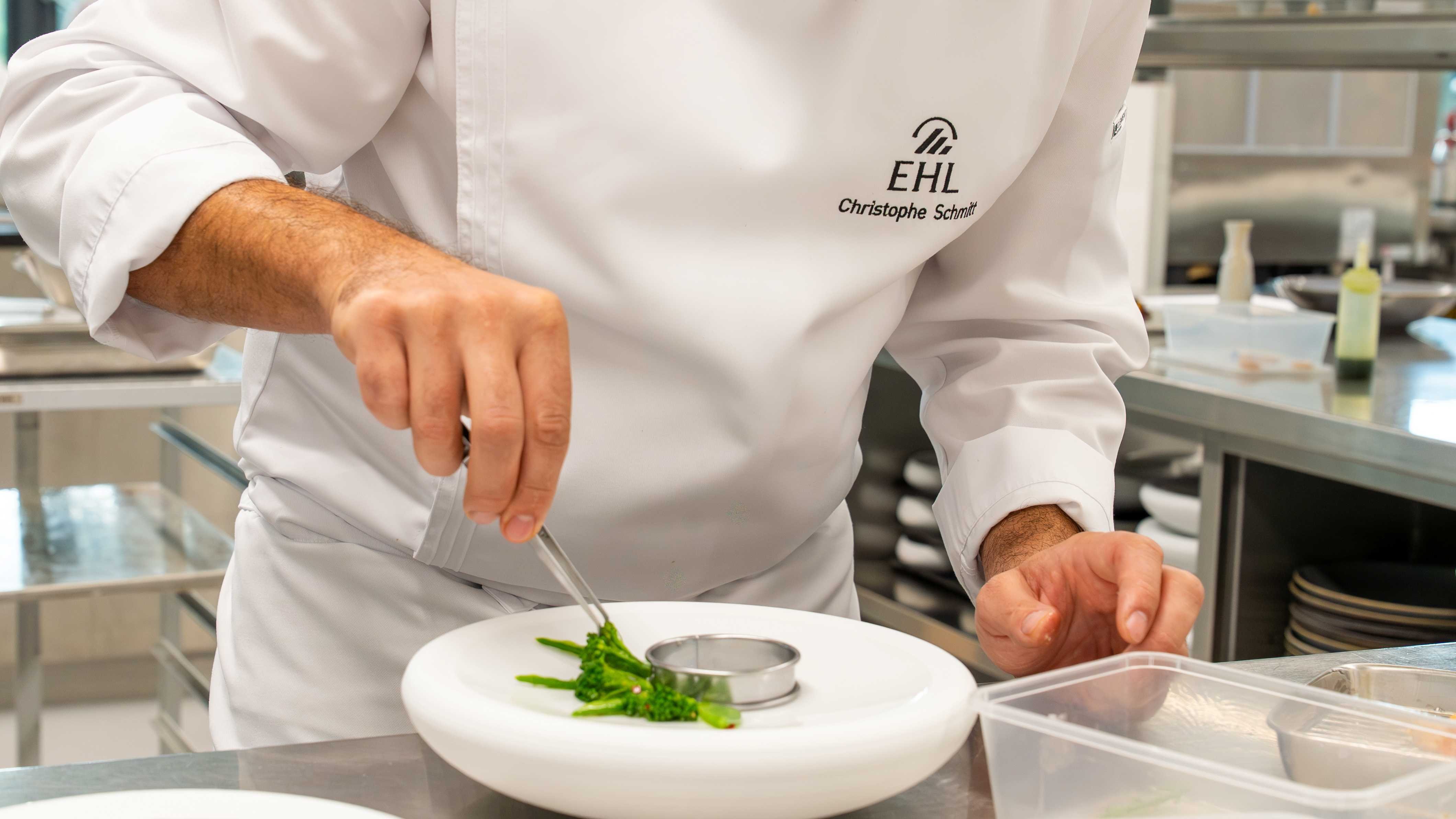
Whisks: Balloon, French, and Flat
What is a whisk?
A whisk is a hand tool made of looped wire attached to a handle, used to incorporate air, emulsify, and blend. The three types used in professional kitchens are:
-
The balloon whisk (wide, rounded, for aeration)
-
The French whisk (narrow and stiff, for sauces and roux in smaller pans)
-
The flat whisk (low-profile, for deglazing and finishing sauces in shallow pans)
Whisks are one of the most underspecified tools in the professional kit and one of the most frequent sources of inconsistency in sauces, batters, and emulsifications. The type matters as much as the technique. Wire gauge and handle material determine performance at professional volumes:
-
Thinner wires flex more and incorporate air faster
-
Thicker wires are necessary for heavier doughs or forceful emulsification.
Stainless steel handles outlast any alternative in a commercial dishwashing environment. Specify both when equipping a station.
Ladles and Portioning Tools
What is a ladle?
A ladle is a long-handled, deep-bowled spoon used to portion and transfer liquids and sauces. Professional ladles are made from stainless steel, sized by volume (typically 30ml to 240ml), and marked on the interior bowl for visual portion verification during service.
At EHL, portion control is taught as a financial discipline as much as a culinary one. Ladle sizing is a P&L decision: a ladle that delivers 20% more sauce per plate than specified is not a generous gesture. It is a food cost problem compounded across hundreds of covers.
Beyond Hand Tools: Essential Kitchen Equipment That Professionals Rely On
Beyond hand tools, professional kitchens depend on sous-vide circulators, vacuum sealers, commercial blenders, and combi ovens. The eight utensils above form the foundation of daily kitchen work. But professional performance also depends on larger equipment systems.
Sous-Vide Circulators and Immersion Equipment
Sous-vide cooking, which defines the technique of sealing food in vacuum bags and cooking at precisely controlled water temperatures, has moved from restaurant novelty to professional standard.
Patrick Ogheard and Bruno Goussault, a world-renowned expert on cooking temperatures and the development of sous-vide cooking, have co-authored La Cuisson à Juste Température (in French), a comprehensive reference covering the science, technique, and food safety implications of sous-vide at a professional level.
Tools like the EHL x Felco 1893 kitchen shears are particularly valuable when prepping food for sous-vide cooking: precise cuts ensure even heat penetration and produce presentation-ready portions before the bag is sealed. For a comprehensive overview, see our guide to professional sous-vide equipment.
Vacuum Sealers
Vacuum sealers are the essential partner to sous-vide equipment, but their utility extends well beyond it. They extend the shelf life of proteins, vegetables, and prepared components by removing the oxygen that drives spoilage. A quality vacuum sealer is a direct contribution to waste reduction and food cost control.
Commercial-Grade Blenders and Food Processors
Consumer blenders are built for occasional, low-volume use. A professional kitchen demands a machine that can run continuously, process large volumes, and produce consistently smooth purées, emulsions, and sauces without overheating or degrading. Commercial-grade blenders, with high-horsepower motors, sealed blade assemblies, and NSF-certified containers, are a different category of tool entirely.
Combi Ovens and Induction Cooktops
Modern professional kitchens increasingly rely on combi ovens, which combine convection, steam, and radiant heat in a single unit, for uniform, programmable cooking across large volumes. Induction cooktops provide rapid, precise, energy-efficient heat control at the stove, and their cool-surface design also reduces kitchen ambient temperature and burn risk.
How EHL's Chefs Select and Evaluate Kitchen Tools
EHL evaluates kitchen tools against four criteria. Every tool used on campus has been validated in real service conditions:
-
Durability under repetitive professional use
- HACCP food safety compliance
- Ergonomics across different hand sizes
- Easy to clean
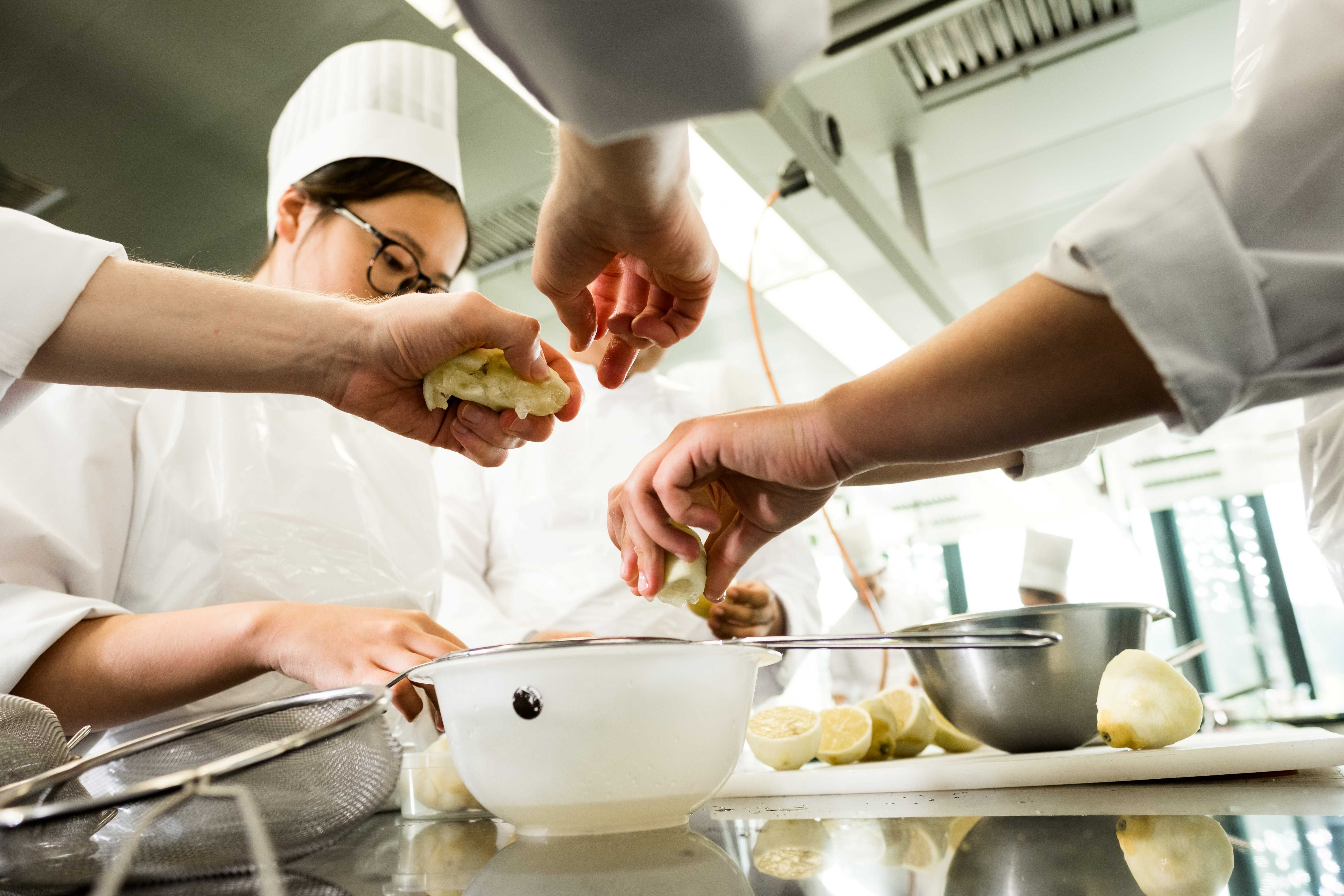
EHL's campus kitchens are working professional environments, serving real covers in pedagogical restaurants, training students in real high-volume as well as fine-dining service conditions. When our culinary teams assess a tool for campus use, they know it will work in any professional kitchen environment, with highly qualified staff as well as beginners.
Caring for Your Professional Kitchen Tools
Basic rules to keep in mind:
-
Hone knives before every service, sharpen monthly
-
Clean kitchen shears after every use, wash with a soft brush, and dry immediately
- Store blades on magnetic strips, not in knife blocks
- Replace worn components rather than whole tools
The best professional kitchen utensils are investments. How you maintain them determines how long that investment lasts, and whether it delivers consistent performance throughout its life.
Knives and Bladed Tools
The most common mistake in professional kitchens is conflating, honing, and sharpening.
-
Honing, drawing a blade along a honing steel, realigns the edge without removing material. It should happen at the start of every service.
-
Sharpening, using a whetstone or sharpening system to remove metal and re-establish the edge geometry, should happen monthly or seasonally, depending on use frequency.
Kitchen Shears
Professional kitchen shears should be easy to clean after every use. It is a food safety requirement:
-
Use hot water and a material-safe detergent
-
Avoid abrasive pads that can micro-scratch blade surfaces
-
After washing, dry thoroughly to avoid residual moisture at the pivot (risk of corrosion)
The Felco 1893 is designed with this in mind. It is dishwasher-safe at 90°C and all parts are individually replaceable. "In a high-volume kitchen, tool maintenance is not a personal habit; it is a team standard. Every shear that comes out of service goes through the same cleaning protocol, every time. The moment you make exceptions, you create risk." Jérôme Zbinden, EHL Kitchen Outlets Manager.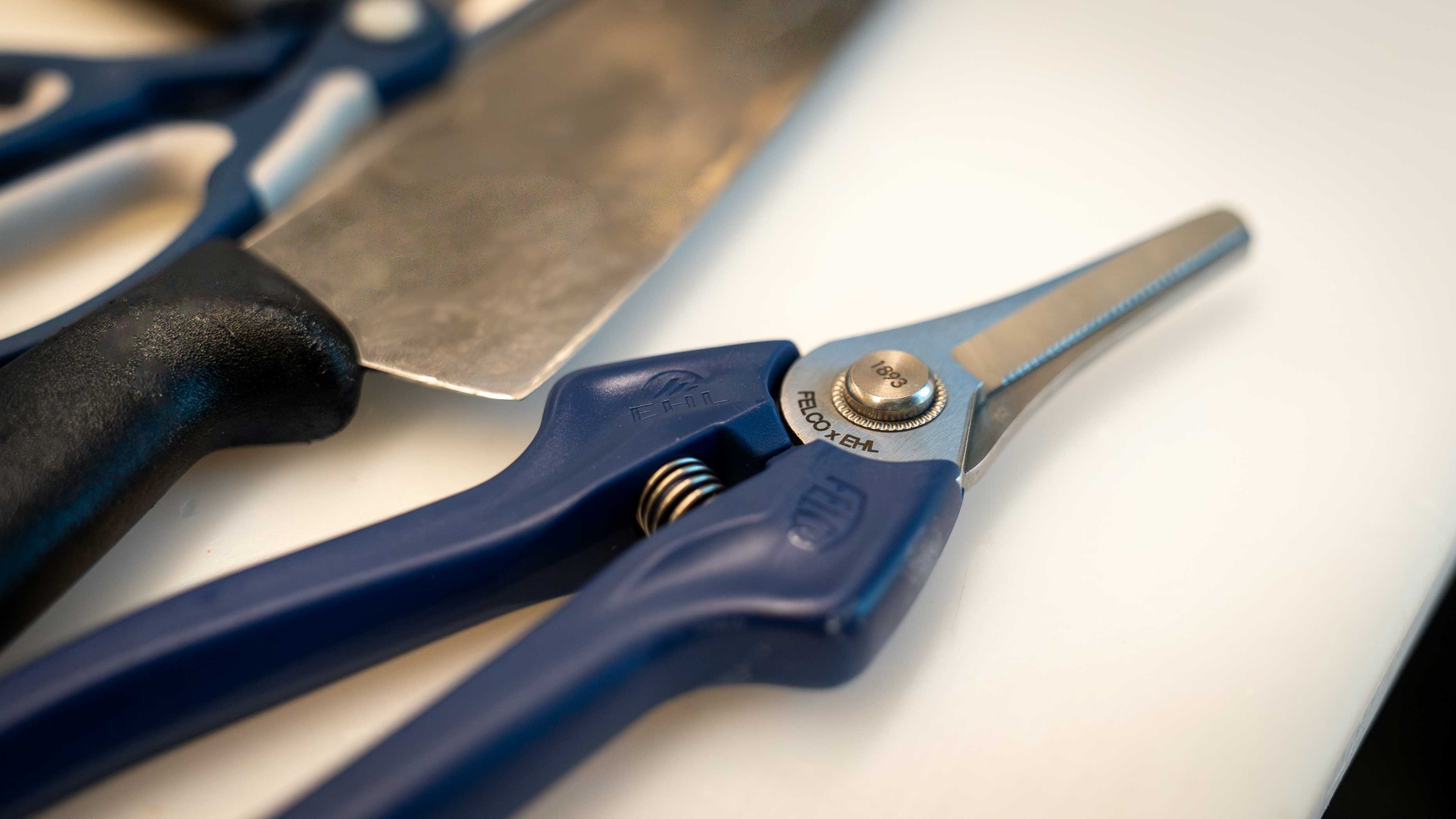
Storage
Magnetic strips are the professional standard for knife and blade storage: they keep edges accessible, visible, and separated, preventing blade-on-blade damage. Knife blocks are less ideal in commercial environments. Their slots are difficult to sanitize and can harbor moisture. Blade guards are appropriate for transport and individual storage but should not substitute for a proper storage system in a working kitchen.
Where to Source Professional Kitchen Utensils
Institution-endorsed tools carry a different level of credibility than consumer reviews. Make sure to choose suppliers who provide:
-
Food-safety certification
-
A clear warranty
-
Available replacement parts
-
A track record in professional kitchens
Sourcing professional kitchen utensils is not simply a matter of finding the lowest price. For a professional buyer, the key questions are:
-
Does the product carry relevant food-safety certifications?
-
Is there a warranty, and what does it cover?
-
Are replacement parts available, or is the tool disposable by design?
-
Does the manufacturer have a track record in professional kitchen environments?
Precision Is a Practice, Not a Product
The best professional kitchen utensils do not make a cook great. They make a great cook more consistent, more efficient, and more capable of expressing what they already know. At EHL, we train the hospitality leaders of tomorrow, and that training includes teaching them to take their tools seriously, from the knife in their kit to the equipment in their kitchens. The collaboration with Felco that produced the Felco 1893 is one expression of that commitment: a tool developed with culinary rigor, engineered to professional standards, and priced for accessibility.
Whether you are a professional chef equipping your kitchen, a culinary student building your first kit, or a serious home cook who holds their tools to a higher standard, the Felco 1893 is available on EHL's Lausanne campus and online.